
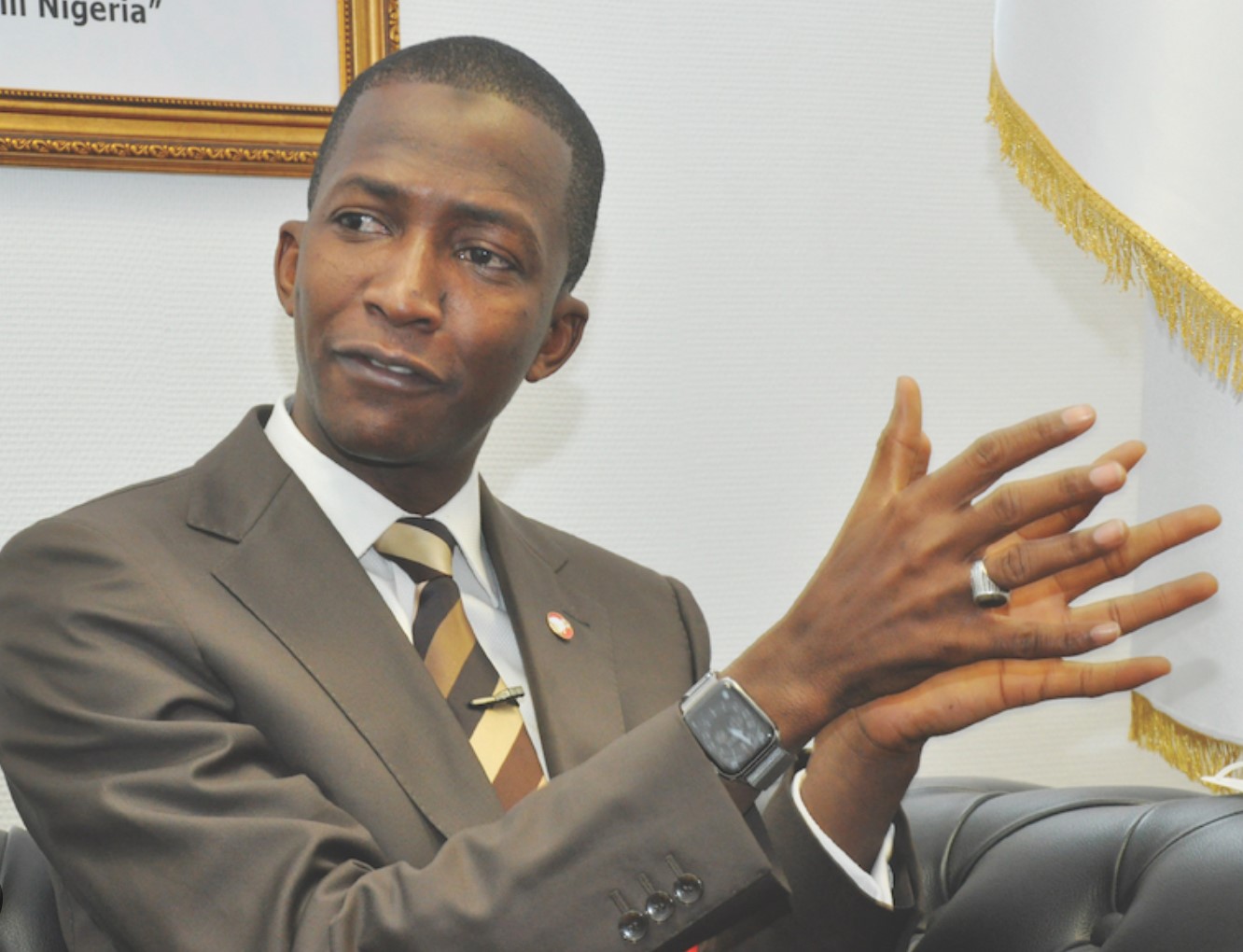
The State Security Service (SSS) has formally confirmed the release of the former president of the Economic and Financial Crimes Commission (EFCC), Abdulrasheed Bawa.
Peter Afunanya, Director of Public Relations and Strategic Communications of the SSS, confirmed Bawa’s release in a statement on Thursday in Abuja.
He said the former EFCC chairman was released on Wednesday night, but did not give details of the deal.
“The SSS confirms the release of former EFCC Chairman Abdulrasheed Bawa a few hours ago today, October 25,” he said.
The News Agency of Nigeria (NAN) recalls that the former EFCC boss was detained by the DSS since June 14 following his suspension by the Federal Government.
Bawa’s release came three days after Newslodge published a scathing editorial calling for his release and that of Godwin Emefiele, the embattled former governor of the Central Bank of Nigeria.
The editorial blamed the government for detaining the two former officials in violation of the Nigerian constitution and other laws.
In case you missed that editorial, it is reproduced below for your reading pleasure.============================================= ==== =============
Two public officials, Godwin Emefiele and Abdulrasheed Bawa, who dominated the Central Bank of Nigeria (CBN) as governor and the Economic and Financial Crimes Commission (EFCC) as chairman respectively, were the first high-profile figures to become entangled in the network of President Bola Tinubu’s nascent anti-corruption campaign. His indefinite suspensions from his positions in June have just been transformed into a permanent departure. The circumstances under which they occurred are anything but transparent and justifiable.
However, the country is in a democracy, whose cornerstones are constitutionalism and the rule of law. The President admitted this during his inauguration when he said that “Nigeria will be governed impartially in accordance with the Constitution and the rule of law.” However, Emefiele’s sufferings since June 10, when he was arrested, and Bawa’s on June 14, negate this position. Strikingly, the Tinubu administration has displayed cavalier violations of the rule of law, lack of respect for court orders and human rights abuses, emblematic of the excesses of the State Security Service.
A news report, citing a CBN statement on September 17, claimed that Emefiele, who was serving his second five-year term, had resigned from his appointment. Two days earlier, his successor, Yemi Cardoso, had been announced, which caused public concern about the legality of said appointment, since previously there was no vacancy, strictly speaking. The CBN Act clearly states how the president can terminate the appointment of a CBN governor. Impeachment must be supported by a two-thirds majority of the Senate, as expanded in Section 11(2)(f) of the Act. Alternatively, the president must wait until a court of competent jurisdiction convicts him of a criminal offense. . The third option is through the resignation of said official, which, in the current circumstances, is suspicious, since no one has seen evidence that Emefiele has actually resigned.
Bawa, detained by the SSS for more than four months, also allegedly resigned as EFCC chairmanship. The Federal Government has not made public the resignation letters of these officials nor have they been allowed to speak publicly about the matter. As things stand, the government will have a hard time convincing anyone that the two resigned out of free will.
We must make no mistake about this, Newslodge does not speak for Emefiele as it has repeatedly called for his removal from office for his gross incompetence in managing the country’s monetary policy space. However, our concern is the lack of due process or legality in the way you are terminated. It is curious that a government that alleged a morass of evidence of his abuse of power did not activate the provision of the CBN Act that requires the Senate’s nod for his removal.
From the initial charge of illegal possession of firearms to financing terrorism, he was eventually charged with 20 counts on August 16, along with his associates, for conspiracy and procurement fraud to the tune of N6.9 billion. The twists and turns that Emefiele’s trials have shown so far are blights on respect for the rule of law credentials of this government: his bail denials, his re-arrest at a Federal High Court, at the Abuja facility , and the open assault on prison staff. by SSS agents, in their attempt to get their way, are sensitive points.
The handling of the Bawa case smacks of impunity and a return to military-era Gestapo tactics, which are alien to democracy. The Administration of Criminal Justice Act (ACJA) 2015, section 493, prescribes only 56 days as the cumulative duration of a remand order. Bawa’s imprisonment from June 14 to October 23, without charge, is unacceptable as it goes against the canons of democracy. Article 35 of the 1999 Constitution, as amended, does not allow such overreach of executive power. Therefore, Tinubu and the SSS should release Bawa now, make his crimes public and charge him in court if necessary.
No authority is above the law in a democracy. The Attorney General and Minister of Justice, Lateef Fagbemi, in his capacity as the Chief Legal Officer of the Federation, should, without further delay, draw the attention of Tinubu to the infamy that the Bawa case has become. The magistrate’s remand order that empowered the SSS to detain Bawa has expired. As Femi Falana (SAN) observed, “it has been spent” and is now “invalid and illegal”.
It is a supreme irony that Tinubu, who often boasts of being one of the Argonauts in the trenches who pushed the military into the barracks, thus paving the way for the birth of the Fourth Republic, turns this disgusting and undemocratic charge. Allegations about Bawa’s possible financial impropriety are whispered in official and public circles, but if not publicly disclosed, they lend credence to a conspiracy’s view that Bawa is only being persecuted for things he might have irritated in his performance. his official position. duties as head of EFCC.
The imprisonment of any person beyond the legal limits, without any publicly known crime or charge, typifies violence against the Constitution. Therefore, former British Prime Minister Margaret Thatcher was right when she pointed out that “any country or government that wants to move towards tyranny begins to undermine legal rights and the law.”
While the circumstances of Bawa’s alleged resignation remain questionable, the Senate confirmed the appointment of his successor, Olanipekun Olukoyede, last Wednesday, in what many consider a violation of Section 2(3) of the EFCC Act 2005 This stipulates that the Chairman of the Commission, “Must be a serving or retired member of any government security or law enforcement agency not below the rank of Deputy Commissioner of Police or equivalent; (who) has no less than 15 years of experience.”
Four months are enough for the government to come clean about its alleged “serious allegations of abuse of power” leveled against Bawa. His predecessors – Nuhu Ribadu, Faridah Waziri, Ibrahim Larmode and Ibrahim Magu – had faced similar wide-ranging accusations and were targeted for removal in actions that were nothing more than the work of vested interests in the corridors of power; and politically exposed powerful people, who were then out of office but still controlled the levers of state power.
Instructively, the rule of law is one of the eight points of Tinubu’s agenda. So far the claim is meaningless. Consequently, AGF Fagbemi has a lot of work to do: first, rein in the SSS, then properly advise Tinubu and push the Global Justice Project’s sermon that the rule of law is “an enduring system of laws, institutions and norms.” and community of commitment, which guarantees accountability, fair law, open government and accessible and impartial justice.”