
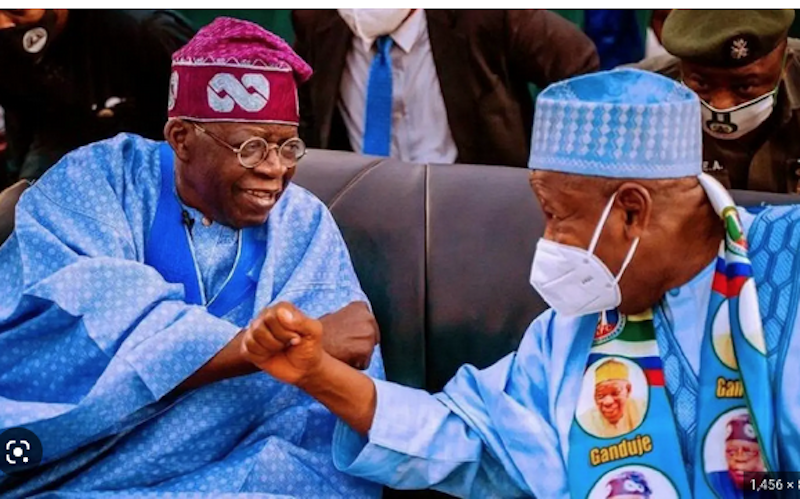
During the presidential campaign, President Bola Tinubu spoke to BBC’s Peter Okwoche in a rare interview and stated, “I am different. I am Bola Tinubu, he is Muhammadu Buhari.” Since taking office, Mr. Tinubu has made efforts to demonstrate to Nigerians that he has distinct qualities from his predecessor, despite both being part of the same All Progressives Congress (APC).
It is evident that in his association with APC, he has made it clear that he will not remain indifferent towards the party’s leadership. This is a departure from Mr. Buhari’s approach as president, who only intervened during times of crisis. For instance, when Adams Oshiomhole was removed as national chairman in 2020, Mr. Buhari entrusted the party to the APC governors through the Caretaker and Extraordinary Convention Planning Committee, led by Governor Mai Mala Buni of Yobe State.
During the previous year, the governors were responsible for allocating the APC National Working Committee seats to their own candidates. It took a lot of persuasion before Mr Buhari agreed to choose the national chairman, ultimately choosing Abdulahi Adamu.
In an interview after the convention, Nasir El-Rufai, the former governor of Kaduna State, revealed that it was the governors who convinced Mr Buhari to pick the former Nasarawa governor.
Muiz Banire, a former legal adviser of the party, criticized Mr Buhari’s lack of understanding of political dynamics which led to wrong decisions when he decided to become active in the party’s affairs. According to Mr Banire, an octogenarian like Adamu could only be an adviser and not the one to administer the party. Instead, someone who is still vibrant and active is needed to administer the party.
The emergence of the former Governor of Kano State, Umar Ganduje, a staunch ally of President Tinubu, as the national chairman and Ajibola Bashiru as secretary offers a preview of the style of the current president. It indicates that the days of the Progressives Governors Forum (PGF) running the party may be over.
Under Mr Buhari, the Adamu-led NWC emerged through a consensus arrangement and careful consideration of regional and bloc interests. Following the abrupt departure of Mr. Adamu some weeks ago, many within the party had predicted that Tanko Almakura, who is also from Nasarawa State, would replace him in line with section 31.5 of the APC constitution, which stipulates the process for the replacement of members of the NWC.
But Mr Tinubu ignored elements within the party that cited the section, including the then national vice chairman, Salihu Lukman, who openly spoke against the nomination of Mr Ganduje.
“No section of the APC constitution gives anyone, including President Asiwaju Tinubu the power to act in any contrary way. Therefore, if this provision of the APC constitution is to be respected, Nasarawa State Executive Committee of the APC, which is where Sen. Adamu comes from should have the right to propose a replacement, which should be endorsed by the State Congress and the Zonal Executive Committee,” Mr Lukman had said.
The president ignored the issues raised, backed Mr Ganduje fully and got the party’s National Executive Committee (NEC) to confirm the decision.
In the past three months, Mr Tinubu has essentially taken control of the ruling party with the appointment of Messrs Ganduje and Bashiru to the two most powerful positions in the NWC.
Furthermore, the exit of Mr Lukman is significant because of the role he played in the removal of three successive national chairmen of the parrty – Messrs Oshiomhole, Mai Mala Buni and Adamu. The Kaduna politician was relentless in pushing for reforms in the party and described Mr Ganduje as “morally unfit” for the seat he now occupies in t6he APC.
Tinubu’s history of holding on to party structure
In the case of Mr Tinubu, he ensures that he controls the structure of the party whenever he had the power. In 2006, when he founded the defunct Action Congress of Nigeria (ACN), he called on his old ally, Bisi Akande, to run the party. And while he was offering the platform to different presidential candidates in 2007 and 2011, Mr Tinubu never dropped his hold on the structure of the party with Mr Akande staying all through.
When the merger with the Congress for Progressive Change, All Nigerian People’s Party and other political parties birthed the APC in 2013, Mr Tinubu ensured that Mr Akande emerged the interim national chairman, until the 2014 convention that produced John Odigie-Oyegun. Mr Tinubu backed the former Edo State governor against Tom Ikimi for the position.
John Odigie-Oyegun
Mr Ikimi, in a piece titled: All Progressives Congress –‘My Reflection’ , accused Mr Tinubu of scheming to retain Mr Akande as the national chairman of the party “ad infinitum” but later settled for Mr Odigie-Oyegun following fierce opposition from some elements within the party.
“His last-minute efforts to rally a South West Leadership support for his absolute power over the party failed and chances of retaining Chief Bisi Akande as National Chairman also evaporated. In the circumstance as the only option was to find a successor National Chairman as well as other National Officers, an illegal process of horse-trading between the Governors and Tinubu was initiated.
“The Interim Executive Council had no knowledge of all these processes. Chief John Oyegun, a Tinubu plan B project said to be favored for his NADECO and SDP credentials and also as one who could be controlled now featured, came into the picture,” the Sani Abacha-era foreign minister said before fleeing the APC.
Two years later, the relationship between Messrs Tinubu and Odigie-Oyegun had reached a breaking point following the primary election that produced Rotimi Akeredolu as the governorship candidate of the party in Ondo State. Mr Tinubu, who backed Segun Abraham for the ticket, held nothing back after the primary as he accused Mr Odigie-Oyegun of collecting bribes and also demanded his resignation.
Mr Odigie- Oyegun survived the call because at that point, the former Lagos State governor was out of favour within the party. For two years, Mr Odigie-Oyegun held on and consolidated power. However, by 2018, with then-President Buhari facing re-election, he brought back Mr Tinubu to the fold and appointed him as chairman of a reconciliation committee. The former Lagos State governor used the position to rekindle the fight with his foe and renewed the ‘Oyegun must go’” rhetoric.
This time, it worked as the “body language of the president” forced Mr Odigie-Oyegun to decline to seek re-election while Mr Oshiomhole, an ally of Mr Tinubu, was adopted by consensus as national chairman at the June 2018 Convention.
Less than six months in the job, Mr Oshiomhole already racked up enough enemies that were calling for his removal, particularly among the powerful APC governors. Mr Tinubu openly supported his ally by insisting that the party is “supreme”.
“We all have to respect the party supremacy. You were all here when we had the Congress, we elected the new executives, we had the convention, the NEC was formed and we surrendered to avoid conflict, to avoid domination, to avoid abuses of power, we surrendered our rights, all rights to the National Working Committee headed by Adams Oshiomhole,” Mr Tinubu said against calls for Mr Oshiomhole’s removal.
Adams Oshiomhole,
The former Edo State governor held on but from Zamfara to Ogun to Imo states, the list of enemies was long, including the wife of the then president, Aisha Buhari.
By June 2020, Mr Oshiomhole met his waterloo. Ironically, it was through his estranged political godson, Godwin Obaseki. The Nigerian Governors’ Forum (NGF), led by Kayode Fayemi, had a multi-party coalition against the former union leader. The APC governors refused to campaign against Mr Obaseki, despite his cross-over to the PDP.
When the Buni-led caretaker was inaugurated, it was a complete takeover by the governors. And Mr Tinubu was remarkably quiet as many speculated that there were attempts to freeze him out of the party. During the last convention that brought in Mr Adamu, once again Mr Tinubu was relatively quiet but candidates he is believed to have supported got the positions of national secretary and youth leader through some of the South-west governors.
Gboyega Oyetola, then governor of Osun, and Governor Babajide Sanwo-Olu of Lagos nominated the National Secretary, Iyiola Omisore, and National Youth Leader, Dayo Israel. Messrs Omisore and Israel later played prominent roles in the primary election that produced Mr Tinubu in June 2023.
Not having the national chairman of the party on his side almost cost him during the presidential primaries but his alignment with the PGF helped to outmanoeuvre Mr Adamu, who had announced former Senate President Ahmad Lawan as the preferred candidate for the APC. Several APC governors openly challenged Mr Adamu.
Is Loyalty Enough to help Ganduje keep his job
During the presidential primaries and the main election, Mr Ganduje stood firm with the former Lagos State governor and moved across the country with him. And Mr Tinubu’s 517,341 votes in Kano was the second-highest that he polled in a state.
Not too long after the presidential election, there were speculations that the parley between Mr Tinubu and Rabiu Kwankwaso could leave out Mr Ganduje in the cold.
Following the meeting between Messrs Kwankwaso and Tinubu in France, there was an audio leak purported to be a conversation between Mr Ganduje and Kabiru Masari, a close ally of President Tinubu. In the audio record, Mr Ganduje was lamenting being sidelined after the election. During the inauguration of the president, there was also a video clip that trended online, where the former Kano State governor was denied access to the VIP section at the Eagle Square because he did not have the VIP access card.
But all the rumours of rift have since been buried, first with the emergence of Barau Jibrin as the Deputy Senate President and after the president also supported Mr Ganduje to emerge as APC Chairman. These two positions came at the expense of the North-central geopolitical zone. Also, during the composition of the cabinet, Mr Tinubu withdrew the nomination of Maryam Shetty after the camp of Mr Ganduje protested against it.
However, holding on to the national chairmanship is complicated and requires more than loyalty to the president. Yes, Mr Tinubu is different from his predecessor on the administration of the party but history has shown that even a rift with a ward chairperson of the party can lead to the downfall of a national leader.