
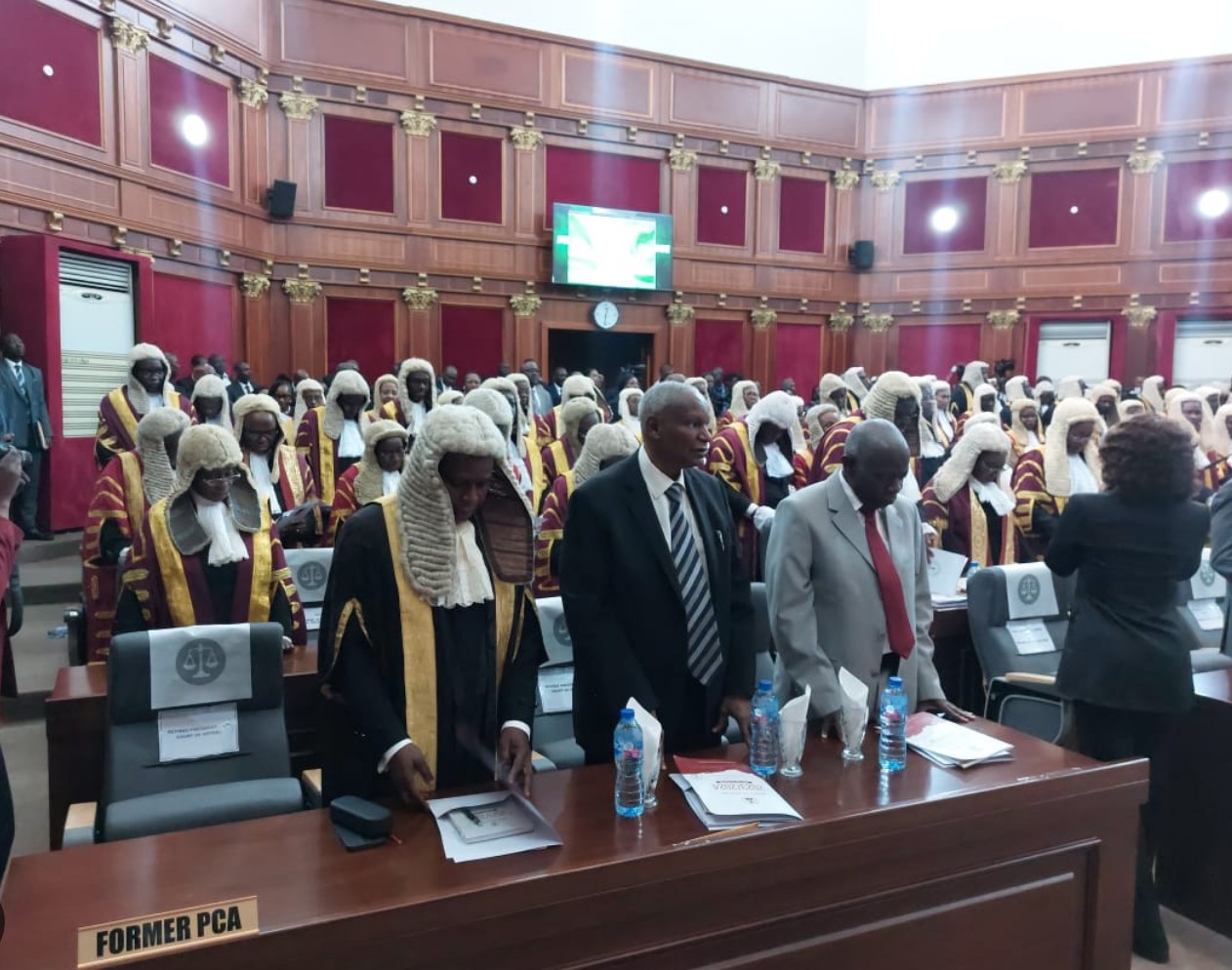
The Chief Justice of Nigeria, Olukayode Ariwoola, swore in nine new Justices of the Court of Appeal on Wednesday, increasing the number of judges to 81 and addressing the huge backlog of cases.
The Court of Appeal occupies a prime place in the hierarchy of courts in the Nigerian judicial system. It is the penultimate court before Nigeria’s highest and final court, the Supreme Court.
The court and its president also have the statutory responsibility to set up and coordinate election petition tribunals that adjudicate on disputes arising from election disputes in the country.
Some new Justices of the Court of Appeal (in the front row) during their inauguration
It also serves as the final court for legislative election disputes. Although it receives and adjudicates on appeals concerning judgements of the governorship election petitions tribunals across the country, its own decisions on the appeals can still be further challenged at the Supreme Court.
The Court of Appeal is also the court of first instance for adjudication on disputes from Nigeria’s presidential elections.
Due to its crucial roles in the socio-economic and political developments as well as its contributions to jurisprudence in the country, Newslodge, in this report, shines some light on the new additions to the court’s bench.
The nine judges newly added to the bench of the court with the states they represent include: Hannatu Azumi Laja-Balogun, Kaduna State; Binta Fatima Zubairu, Kaduna State; and Peter Chudi Obiora, Anambra State.
They rest are: Okon Efreti Abang, Akwa Ibom State; and Asma’u Musa Mainoma, Federal Capital Territory, Lateef Adebayo Ganiyu, Oyo State, Jane Esienanwan Iyang, Cross River State; Hadiza Rabiu Shagari, Sokoto State; and Paul Ahmed Bassi, Borno State.
Okon Efreti Abang
Justice Okon Abang
Mr Abang, 61, who hails from Oron in Akwa-Ibom State, South-south Nigeria, needs no introduction given some high-profile and sometimes controversial cases he has handled in his 14 years judicial career as a judge of the Federal High Court.
He is reputed for the relative dispatch with which he handles criminal cases, in a country where such cases particularly those involving politically-exposed persons proceed perpetually.
In February 2020, the Court of Appeal division in Abuja, praised Mr Abang for making appreciable progress in the hearing of a N3.1 billion fraud case involving a former governor of Benue State, Gabriel Suswam, after the case suffered delays before another Federal High Court judge, Ahmed Mohammed.
“Justice Abang has shown commendable diligence in the trial,” Emmanuel Agim who delivered the lead judgement in an appeal lodged by Mr Suswam to have his case retrieved from Mr Abang and returned to Mr Mohammed, had said.
In a landmark decision, Mr Abang in November 2021, jailed a former chairperson of the defunct Pension Reform Task Team (PRTT), Abdulrasheed Maina, for money laundering offences involving N2 billion in pension funds.
Given the trajectory of Mr Maina’s trial after he jumped bail and was rearrested in Niger and returned to Nigeria amid other high-powered scheming during the President Muhammadu Buhari’s regime that saw Mr Maina reinstated to the civil service, many Nigerians lauded Mr Abang for his courage in finding the pension thief guilty.
Delivering another consequential decision last December, the jurist sentenced nine drug traffickers, including four internationally-wanted Mexicans, to 10 years imprisonment each.
This newspaper reported that Mr Abang jailed the convicts for producing cocaine-like drug – methamphetamine – and extracting ephedrine, another illicit substance, at the laboratory located in a warehouse in Delta State.
The judge also chastised the prosecuting agency, the National Drugs Law Enforcement Agency (NDLEA), for entering into a plea agreement with the drug barons despite sufficient evidence to earn a conviction and secure a stiffer penalty for the culprits.
“The defendants made confessional statements that would even secure conviction on their own,” Mr Abang said, insisting that the plea bargain agreement was indefensible.
However, Mr Abang’s handling of the trial of Olisa Metuh, a stalwart of the opposition Peoples Democratic Party (PDP) put his court in the spotlight.
He had in February 2020, sentenced Mr Metuh to seven years imprisonment after finding him and his firm, Destra Investment Limited, guilty of charges of money laundering involving the sum of N400 million they received from ex-National Security Adviser, Sambo Dasuki, in 2014 preparatory to the 2015 general elections.