
…CONTINUE READING
As India heads into the world’s biggest election, Muslims tell Shweta Sharma of growing anxiety and fear of persecution after two terms of the Modi government marked by rising polarisation in the country
For free real time breaking news alerts sent straight to your inbox sign up to our breaking news emailsSign up to our free breaking news emails
Mohammad Saad was excited to return home in eastern India’s Bihar and see his family. He had bought a train ticket and was packed to leave in the morning, but he never made it.
On that night of 31 July 2023, a mob of around 200 Hindus stormed the Anjuman mosque in Gurugram where Saad served as the deputy imam and killed him in his sleep. The mob also burnt down the mosque.
Sectarian violence had erupted in the neighbouring Nuh region and quickly spilled over into Gurugram, a shiny satellite township of India’s capital Delhi that hosts the offices of multinational corporations like Google, Meta and Deloitte.
The violence in Gurugram was a reminder that the increasing persecution of religious minorities, particularly Muslims, was not confined to the hinterland.
It also reinforced accusations by critics that Narendra Modi’s Hindu nationalist government had mainstreamed sectarian violence, for which Saad, 22, who would sing about religious harmony in social media videos, paid the price.
“I had spoken to Saad just half an hour before he was killed. He was excited to leave for home in the morning despite my concerns about the escalating violence in Nuh,” Shadab Anwar, the slain cleric’s brother, tells The Independent.
“He had multiple knife wounds on his chest and neck suggesting a frenzied and prolonged assault. That night everything changed for our family. I lost a brother and my father and mother lost a son to Muslim hate in this country.”
While Anwar is still awaiting justice for his slain brother, Indian authorities moved promptly to bulldoze hundreds of homes and shops in Nuh in an act of collective – and extrajudicial – punishment for the local Muslims they accused of inciting the violence, which had left six people dead.
Now, nearly nine months later, as Anwar’s family prepares to vote in the national elections, they are compelled to mull what a third consecutive term for Modi would mean for them and the 200 million Muslims who call the country home.
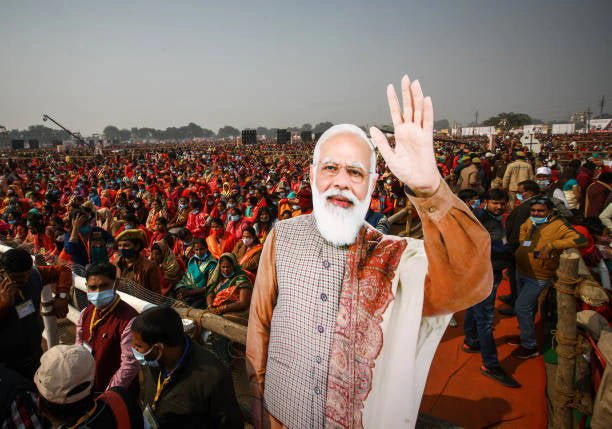
Supporters of Narendra Modi at a campaign rally held by the prime minister (Getty Images)
Modi’s decade in power has seen a surge in hate speech against religious minorities, attacks on their places of learning and worship and mob lynchings.
In recent years, Indian authorities have invented “bulldozer justice” to punish Muslims for real and imagined offences. The demolition drive in Nuh was so blatantly discriminatory – 283 Muslim and 71 Hindu properties were targeted – Haryana’s high court asked the state government if it was carrying out “an exercise of ethnic cleansing” against Muslims.
All while Hindu hardline groups such as the Bajrang Dal and the Vishwa Hindu Parishad, which are aligned with the ruling Bharatiya Janata Party (BJP) and boast thousands of members, have been operating with impunity.
“We have been vilified to the extent that Hindus have started refusing jobs to Muslims and they avoid mingling with us. I invited 10 Hindu families to a function at my home but only three people turned up,” says Altaf Khan, a resident of Delhi.
Khan says he is worried for his children as the situation for Muslims in the country is growing grimmer by the day.
Khan’s worry isn’t misplaced, as evidence of what Muslim scholar Qari Nasaruddin calls “injustice” and “Muslim hate” is not hard to find.
Nasaruddin points, by way of example, to the rubble of what once was a mosque, a Muslim graveyard and an Islamic school in the heart of the national capital. Nasaruddin is the imam of a mosque in Mehrauli which took in the displaced children.
The sprawling complex was demolished on 30 January by the Delhi Development Authority, run by Modi’s federal government, claiming that it was an illegal encroachment.
It didn’t matter that the Akhoondji mosque was a site of historical significance built nearly 600 years ago in the same part of the city that boasts the iconic Qutub Minar.
The symbolism of the mosque being demolished barely days after Modi had presided over the inauguration of the new Ram Temple in Ayodhya – erected on the ruins of the medieval Babri mosque that was torn down by a Hindu mob in 1992 – wasn’t lost on the city’s Muslims.
In neighbouring Uttar Pradesh, governed by a Hindu monk called Adityanath, the high court effectively banned Islamic schools in the country’s largest state by declaring a 2004 law regulating them unconstitutional. The order, which would have dislodged around 2.7 million students, has since been put on hold by the Supreme Court.
Islamic schools, called madrasas, mainly serve poor or orphaned children.
Muzammil Ahmed, who teaches such children in Delhi, says Indian authorities are going after Islamic schools supposedly to check radicalisation but it is just “another conspiracy to malign Muslims”.
“Most of the children who come to us are orphans or have a single parent and those with both parents are from economically disadvantaged backgrounds. By providing education, shelter, and food, we are only lightening the burden on the government,” he tells The Independent.Rubble of the Akhoondji mosque strewn with books from the associated Islamic school
Rubble of the Akhoondji mosque strewn with books from the associated Islamic school View pictures in App save up to 80% data.Rubble of the Akhoondji mosque strewn with books from the associated Islamic school (Shweta Sharma/The Independent)
Munir, a data scientist in Haryana who was fearful to give his full name, says Muslims now feel a clear bias in government policies.
“The normalisation of hatred has been very disturbing and the government’s reaction to it all is even more alarming to us minorities,” he says. “We have seen that no action is taken when there is violence against the minorities but if people from the Muslim community raise their voice they find a bulldozer standing outside their house.”
India Hate Lab, a research group in the US, documented 668 incidents of hate speech against Muslims in 2023, of which 413 took place in the last six months of the year, coinciding with elections in four key elections.
In the decade since Modi took power, “what has exponentially increased is runway hate speech spouting venom against Muslims”, including calls for genocide by politicians and Hindu religious leaders, says social activist Harsh Mander.
“India is witnessing an alarming rise in hate speech and targeted violence against individuals which we call mob lynching, word that was not even used earlier because it wasn’t a common grind.”
“This could not happen except for an environment of encouragement and enablement and indeed by validation because these are the acts of open indictments for violence.”A Rashtriya Swayamsevak Sangh march in Ajmer, Rajasthan. The Sangh is the mothership of Hindu nationalist organisations in India including the ruling BJP. View pictures in App save up to 80% data.A Rashtriya Swayamsevak Sangh march in Ajmer, Rajasthan. The Sangh is the mothership of Hindu nationalist organisations in India including the ruling BJP. (AFP via Getty Images)
In the run-up to the national elections, the Modi government operationalised the Citizenship Amendment Act, which was passed by the parliament in December 2019 but put on the backburner after it sparked nationwide protests. The law openly discriminates against Muslims.
In a related move, the BJP government in the northern state of Uttarakhand enacted a Uniform Civil Code, a law criticised for overwriting the “personal laws” of religious minorities with seemingly Hindu laws. The BJP has long promised to roll out a similar code nationally, in line with the agenda of the Rashtriya Swayamsevak Sangh (RSS), a paramilitary volunteer organisation advocating for India to be made a Hindu nation. The RSS is the mothership of a network of Hindu nationalist groups, including the BJP.
In fact, the BJP was established in 1980 as the political arm of the RSS. It has come to dominate Indian politics under Modi’s leadership, making him the longest-serving prime minister from outside the Congress, the main opposition party.
In recent years, Hindu groups, and their ideological fellow travellers in the media, have also targeted Muslims with conspiracy theories such as “love jihad”, “land jihad”, “halal jihad”, and “population jihad”, which claim the minority community is deviously luring away Hindu women, taking over land and increasing their numbers.
“These are basically a series of quite fantastical conspiracy theories. These are absurd and they call to memory the kind of conspiracy theories that were created against the Jews before the holocaust,” Mander says.
“It is bad enough that they simply circulate on social media but these are also the terms that have been used by chief ministers and ministers of the ruling party. Then it becomes concerning.”
The love jihad conspiracy in particular has led to people being killed and a dozen states ruled by the BJP to effectively criminalise religious conversion and interfaith relationships.
The US Commission on International Religious Freedom has pointed out that such laws enable and embolden “existing government harassment, vigilante violence, and discrimination against religious minorities, as well as crackdowns on civil society organizations”.Parvez Qureshi, brother of Faheem Qureshi, who was killed in sectarian violence in Uttarakhand’s Haldwani in February. India has a long and grim history of violence against minorities View pictures in App save up to 80% data.Parvez Qureshi, brother of Faheem Qureshi, who was killed in sectarian violence in Uttarakhand’s Haldwani in February. India has a long and grim history of violence against minorities (AFP via Getty Images)
In this context, Mander says, a third term for Modi is “particularly terrifying”.
In 2014, he adds, there was still hope as he promised to fight corruption, create 240 million jobs and build a stronger economy.
“It is a frightening time for India’s Muslims. The status of Muslims has been altered and there is no hope of reversing the damage done to the social fabric with him getting a third term. The hate has been normalised,” the activist argues.
Apoorvanand, a professor and political commentator, says Hindus, who number over a billion, have been misled into thinking that it is going to be their rule.
“It is the RSS that is going to rule and dictate all aspects of the lives of Hindus,” he says. “The Hindus need to realise that they are handing themselves over to an organisation that follows the idea of homogeneity and wants to homogenise Hindu religion.”
Prof Apoorvanand says it is “already a disastrous situation for Muslims” and it will be catastrophic if the BJP continues to tighten its grip on power.
“Muslims in India are being marginalised and cornered systematically under what is the ideology of the BJP,” he says.
At a rare press conference in the US last year, Modi declared that “democracy runs in our veins” when he was asked about his government’s alleged discrimination against minorities.
“We live in a democracy,” he said, standing alongside his host, US president Joe Biden. “Our government has taken the basic principles of democracy … we have always proved that democracy can deliver. And when I say deliver, this is regardless of caste, creed, religion, or gender. There is absolutely no space for discrimination.”
“There is absolutely no space for discrimination,” he added. “And when you talk of democracy, if there are no human values and there is no humanity, there are no human rights, then it’s not a democracy.”
The Independent reached out to BJP spokespersons for comment but did not receive a response.