
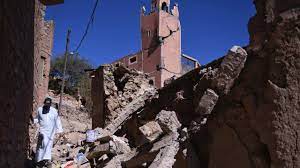
Moroccans affected by the 6.8 magnitude earthquake that hit the North African country on September 8 are asking for humanitarian aid as they search and hope to rescue their loved ones who are still trapped under the rubble. However, the country’s leaders have been selective in accepting aid.
Since the disaster in villages in the Atlas Mountains, which has already claimed approximately 3,000 lives, the country has accepted aid from only four countries: Britain, Qatar, Spain and the United Arab Emirates. A rescue mission in such a crisis – the worst earthquake to hit the region in at least a century – is most useful within hours of the incident, experts say, noting that rescuing someone alive after four days It is unlikely.
Several countries and the United Nations have offered to help, but the Moroccan government has not accepted most of these proposals. Turkiye, a neighboring country with plenty of experience in search and rescue efforts after last winter’s terrible earthquake, still has its offer on the table. The UN said it could provide humanitarian support and coordinate resources on the ground for victims, but is awaiting approval from the Moroccan government.
Farhan Haq, deputy spokesman for Secretary-General Antonio Guterres, told reporters on September 11 that the UN is willing to collaborate, but must be invited.
“Our standard procedure is to wait and be prepared,” Haq said Monday, three days after the earthquake. “We are making clear to the Moroccan authorities the type of assistance we are willing to provide. We have the capacity to bring all types of necessary humanitarian assistance. “We are discussing this with the authorities and we will see what we can offer.”
Fouad Abdelmoumni, a Moroccan human rights activist, said one of the reasons Morocco has refused to accept offers from the UN and others is to show that it is a regional power and does not need help from foreigners. The country is a constitutional monarchy, with a parliamentary system governed by King Mohammed VI.
“The authorities do not want to accept help from Algeria and France, but since they do not want to be explicit in excluding them, the authority is making this a general policy,” Abdelmoumni said. “Also, the sellers of the king’s image are worried that people will come here and return with the official image of how much the people suffered in very harsh conditions before the earthquake and how these areas were totally abandoned, how the government is weak, corrupt and inefficient.”
Rabat, the capital, has a difficult relationship with both Paris and Algiers over the disputed territory of Western Sahara, located on the northwest coast of Africa and bordering Morocco, Mauritania and Algeria. Morocco wants France and Algeria to formally recognize the territory as Moroccan. The UN established a referendum mission in Western Sahara in 1991 to help organize a vote by the Sahrawi people in the territory to decide on Western Sahara’s independence or its integration into Morocco. The referendum has never been held. The UN personal envoy for Western Sahara, Staffan de Mistura, was recently in Morocco, meeting with Nasser Bourita, Minister of Foreign Affairs, on September 8.
King Mohammed VI was in France when the earthquake hit his country on Friday night. He made his first visit to the Marrakesh area, about 44 miles from the epicenter, four days after the earthquake. Moroccan officials made no comment, did not appear on the scene or give instructions on rescue missions until the king’s arrival. News reports say the king has a mansion in Paris, despite the diplomatic rivalry between the two countries.
A source familiar with the ruling elite in Morocco said state officials are afraid to do anything that is not authorized by the king. Although Morocco has a prime minister as head of government, the monarch has tremendous power and autonomy.
“Morocco tries to present itself as a modern society that has elections and political parties, but that is all a facade. “It is a very authoritarian and despotic regime,” the source said. “What you see is similar to the same thing in North Korea, and this earthquake has shown it because no one could do anything until the king arrived. The system is too centralized. In disasters, quick decisions are needed, but this was not possible because all decisions rest with the king, who was far away.”
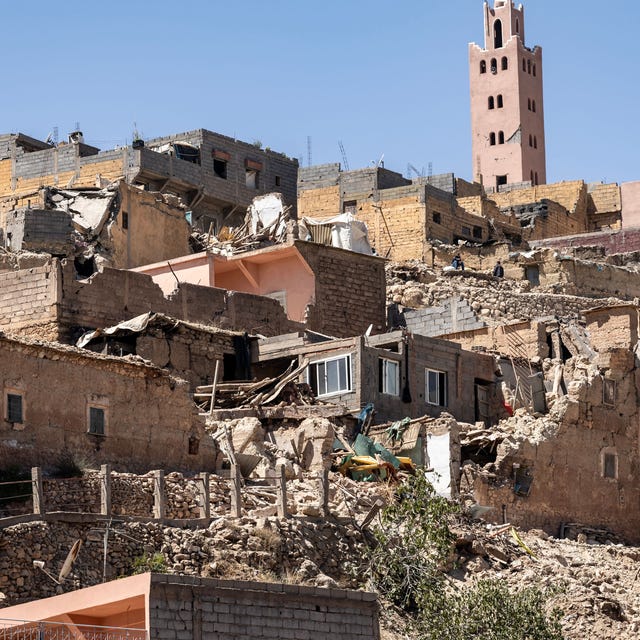
Videos and images emerging from the site of the earthquake (most of the fatalities occurred in the Al Haouz district) show citizens using basic equipment such as shovels and hammers to separate the rubble in search of people trapped below. Survivors have asked for help because the rescue has been slow and humanitarian aid limited.
A teacher posted on Facebook, Morocco’s most popular social media platform, that all her students were dead. Another survivor told Reuters that she had no access to food or shelter. In another image, posted on social media, an injured man lay outdoors while someone helplessly watched over him.
People sleep in makeshift tents near the earthquake ruins. With rain predicted to hit the area soon, Abdelmoumni said it “promises to be a very bad situation” for survivors, who are already dealing with the loss of family and property.
Mosa’ab Elshamy, an Associated Press photojournalist based in Morocco, said on his Facebook page that the stench of dead bodies was beginning to fill the atmosphere. Abdelmoumni corroborated this description during another telephone interview.
“We also have problems when it comes to burying corpses because representatives of the authorities threaten those who bury corpses without public authorization with going to jail,” he said. “The deceased are beginning to smell very bad and there is a risk of an epidemic occurring as a result of this situation.”
Humanitarian groups operating in the area said food, medicine and shelter were some of the survivors’ most urgent needs. He World Central Kitchena non-governmental organization, said it was providing hot meals to the people of Marrakech.
“The WCK relief team was on the ground within hours of the quake, using all necessary means to reach the most affected areas and provide immediate support,” the group said in a statement posted on its website. “We are providing sandwiches, fruit and water to offer immediate support and our team in Spain is on the way with several food trucks and kitchen equipment to start cooking fresh meals as soon as possible.”
Moroccan authorities continue to reject criticism that they are playing geopolitics with the desperate needs of their citizens. Abdelmalek Alaoui, president of the Moroccan Institute for Strategic Intelligence, told Al Jazeera that the government wants to manage how aid is delivered so as not to create more problems.
“Morocco has not rejected international aid, it is trying to channel it in the best way to serve the best interests of the population,” he said.
Alaoui acknowledged that one problem with accepting all the help that is offered is that “there is only one road” that connects to the region where the earthquake occurred. “You only have one path, you have a very long column of logistics trying to get there. We have to make sure that aid does not add one problem to another,” Alaoui said.
Abdelmoumni said responses could have been quicker if all decisions did not come from the king. Meanwhile, the number of people who have died continues to rise, according to the Moroccan government news site. The U.S. Agency for International Development, which has contributed “up to” $1 million toward earthquake recovery, said in a Sept. 13 statement: “First responders have spent hours searching for those still trapped. “Citizens have stood in long lines to donate blood.”