
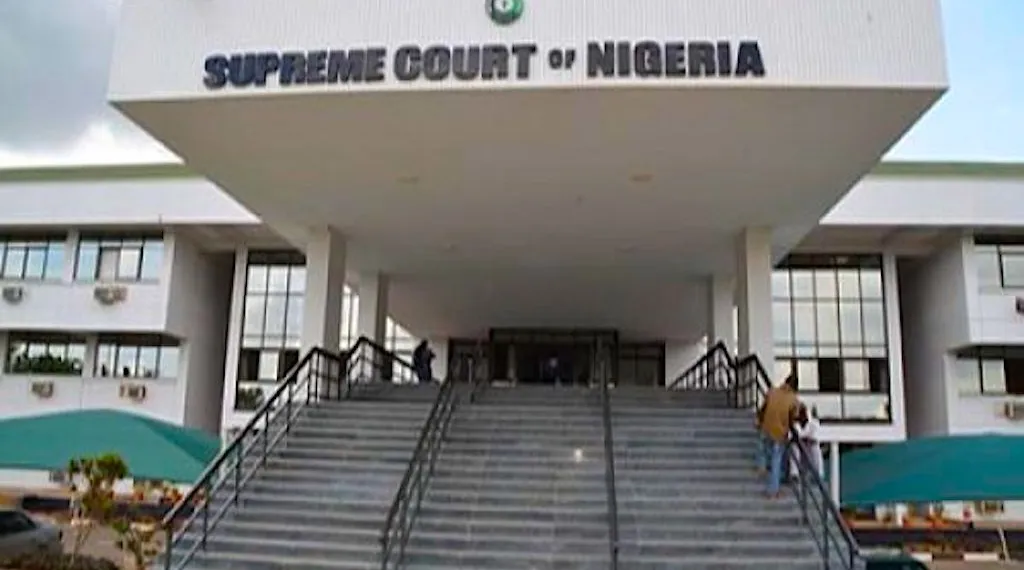
Nigeria’s number Supreme Court The number of judges is about to be reduced to 10, well below the court’s total legal strength of 21 judges.
The number, currently 11, will be reduced to 10 when another judge on the court retires on October 27.
In the space of three years, the number of judges on the court plummeted from 20 to 14 in June 2022, when the then Chief Justice of Nigeria (CJN), Tanko Muhammad, abruptly resigned.
The number has since been further reduced to 10, as Musa Dattijo Muhammad, who joined the Supreme Court more than a decade ago, retires on October 27.
He is the second most senior judge on the court.
The jurist’s retirement will bring the number of court justices to 10, an all-time low in the recent history of the Supreme Court.
A statement by the Director of Press and Information of the Supreme Court, Festus Akande, on Sunday, said Muhammad reaches the mandatory retirement age of 70 years on October 27.
He also said that a farewell court session would be held on Friday, October 27, to mark Muhammad’s departure from office.
The event, scheduled for 10 am on Friday at the Supreme Court, will be presided over by the CJN, Olukayode Ariwoola, “who will usually pay tribute to Justice Musa Dattijo along with other important players in the country’s judicial sector”, added the statement.
In September, the retirement of Amina Augie reduced the number of Supreme Court justices to 11, following the sudden disappearance of Centus Nweze in July.
At the beginning of June, the CJN announced 10 vacancies aimed at achieving the court’s full complement of 21 magistrates; However, with the departure of Mr. Muhammad, the court will now be left with 11 vacancies.
A senior source in the National Judicial Council (NJC) told Newslodge on Sunday that “the process of filing for the 10 vacancies in the Supreme Court has reached an advanced stage.”
The NJC is the statutory body responsible for the recruitment and discipline of judges in Nigeria.
Muhammad’s departure leaves the Supreme Court bench with: Olukayode Ariwoola (CJN), CJN, Kudirat Kekere-Ekun, Inyang Okoro, Uwani Abba-Aji and Lawal Garba.
The rest include Helen Ogunwumiju, Ibrahim Saulawa, Adamu Jauro, Tijjani Abubakar and Emmanuel Agim.
Outgoing Judge Muhammad
In its statement on Sunday, the Supreme Court shared a brief profile of Mr. Muhammad, born in Niger State, who retires from his position at the Supreme Court on October 27.
He began his legal career in 1977 when he was called to the Nigerian Bar after obtaining a Bachelor of Laws from the Ahmadu Bello University, Zaria, Kaduna State.
“Justice Musa Dattijo, a native of Chanchaga Local Government Area of Niger State, was born on Tuesday, October 27, 1953 in Minna. He attended Native Primary School, Minna from 1960 to 1966 to obtain his first school leaving certificate.
“Between 1967 and 1971, he was at Sheikh Sabbah College (now Sardauna Memorial Secondary School), Kaduna, from where he proceeded to Abdullahi Bayero College, Kano, for an undergraduate program which aided his immediate admission into the Faculty of Law of the University Ahmadu Bello, Zaria, where he obtained a Bachelor of Laws degree in 1977.
“He was called to the Nigerian Bar on July 2, 1977. Not satisfied with just a first degree in Law, Justice Dattijo sought admission to the University of Warwick in 1982 to pursue an LLM degree which he obtained in 1983.
“He was sworn in as a judge of the Supreme Court on Tuesday, July 10, 2012. His promotion to the Court of Appeal was more of a reward for hard work, inherent passion for his chosen profession, dedication to duty and, above all, , a determined application of the law in its true letters and words to all cases that came to him.
“He earned a well-deserved promotion to the Court of Appeal on November 21, 1998 by the Niger State Judiciary and served meritorious in different divisions.
“With the retirement of Justice Musa Dattijo Muhammad, the Supreme Court of Nigeria is now left with 10 judges,” the statement read.