
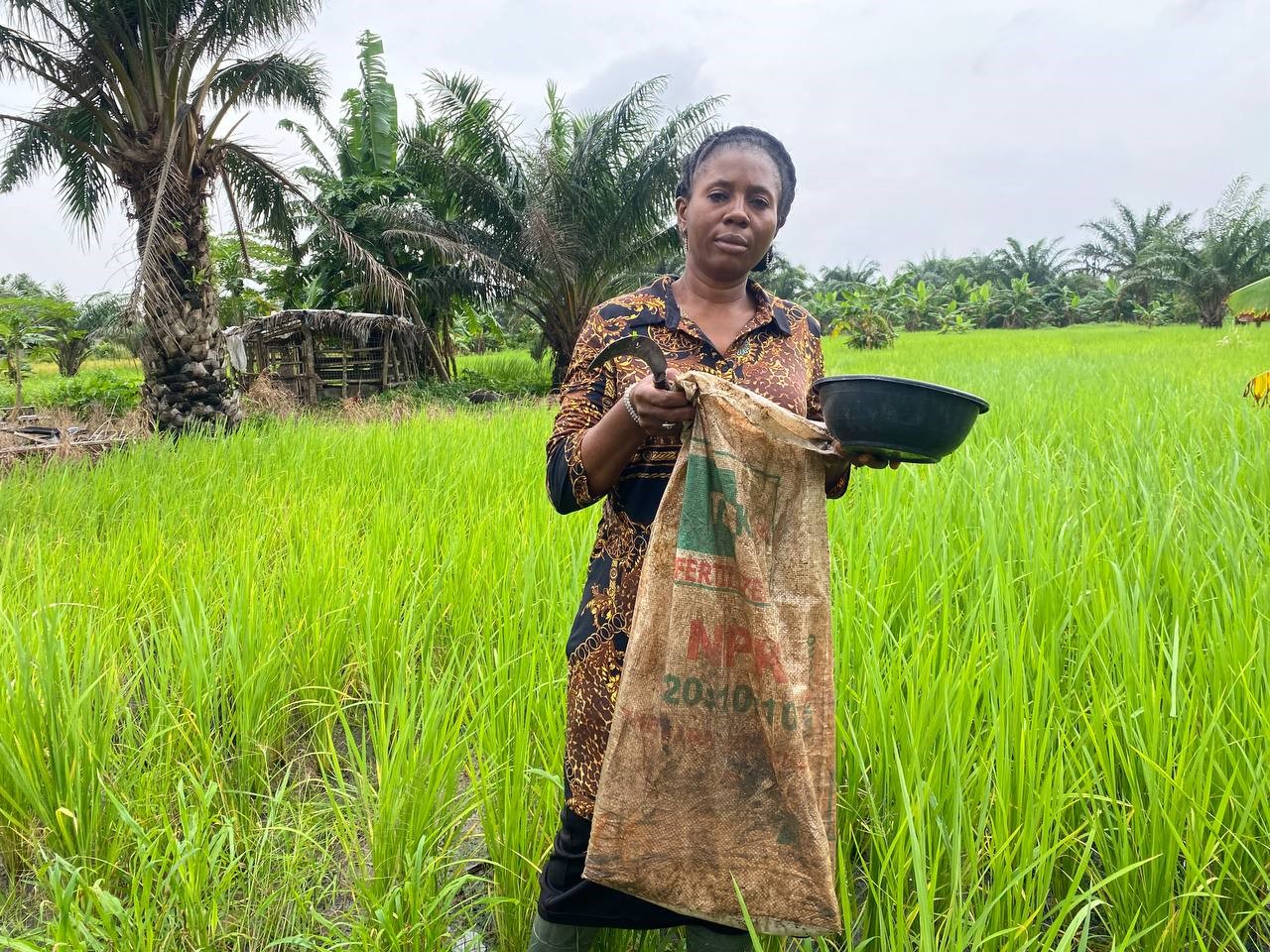
Salifu James needs six to eight 50kg bags of fertilizer for his 35 acres of rice and sugarcane crops. But this 49-year-old farmer was only able to buy a single bag this year. To make up for the low amount, he adopted the broadcast fertilizer application method: spreading the substance evenly across the field.
“I need the required amount per acre to get the right result, but I bought NPK 20:10:10 fertilizer at N27,000 so I have to manage what I can afford because I have to buy other inputs,” Mr. James told PREMIUM . TIMES at his farm in Igbalu, a community in the Imota area of Ikorodu, Lagos State. He knows that the situation will affect his performance at the end of the season, but he is helpless.
There are many groups of farmers who produce rice and sugar cane in the community, but for many of them, the high price of fertilizers is a major source of headache. Ajulo Mojisola could only cultivate a part of his one-acre farm due to the increased cost of inputs, especially fertilizers. “I reduced the size of the farm according to the amount of fertilizer that I could afford,” said Ms. Mojisola.
Salifu James on his farm. government intervention
the plight of lakes state The Farmers reflects the challenges faced by farmers in Nigeria despite the intervention of the Nigerian government through the Presidential Fertilizer Initiative (PFI) launched by former president Muhammadu Buhari in December 2016 to increase local production and make critical agricultural inputs affordable for farmers.
Through local production, the PFI projected that the fertilizer would sell for N5,500 per 50 kg bag to farmers. The Nigerian Sovereign Investment Authority (NSIA) implements the initiative through its subsidiary, NAIC-NPK Limited. The NSIA-supported intervention was designed to stimulate local production of NPK fertilizer and make it available to farmers at affordable prices, while saving the country US$200 million per year on fertilizer imports and ₦60 billion on annual budget in subsidies for fertilizers.
Chat
He initiative local fertilizer production improved, as the country produced more than 2.97 million metric tons of the commodity. This was achieved through the revival and establishment of 52 mixing plants in 19 states of the country.
Presidential Fertilizer Initiative
The PFI also produced more than two million metric tons and the data revealed a decrease in the volume of imported fertilizers in the last four years.
Nigeria – NPK Fertilizers – Import Quality
According to the Food and Agriculture Organization of the United Nations (FAO), the amount of imported fertilizer in Nigeria steadily decreased to 154 tons in 2020, from 23,3032 tons in 2016.
But the initiative’s impact has been inadequate as farmers lamented how the rising cost of fertilizer affects their production, profitability and the nation’s food sustainability.
One rice farmer, Chinasa Asonye, said she only bought fertilizer once at 5,500 naira in 2016. Now she buys it at 25,000 naira. “My profitability has been reduced because fertilizer is very expensive and scarce,” she lamented.
Due to the high cost of fertilizer, Ms. Asonye said she has to increase it with rice husk, but the production has been poor.
Sky-high fertilizer prices
A fertilizer vendor, AbdulRauf Suleja, said he sources his supply from within the country but sells well above N5,500. “The last time I sold for N5,500 was in 2017. Now a bag costs no less than N19,000,” he said.
Kefas Isuwa, another retailer, said the price varies as it sells the Golden Fertilizer brand for N27,800 and the Synergy brand for N18,500. “These prices are above 5,500 naira,” he said, adding that his profit margin is usually very low, just 500 naira, due to the high market price of fertilizers.
“The variation in the sale price is due to the location of the offer. To be honest, getting fertilizer from Nigeria is not cheaper,” Kefas said.
For Mikailu Kasimu, another retailer, purchasing product from mixing plants can be quite difficult. He noted that, on average, he gets it at N17,500.
Salifu James and Rebecca Eche applying NPK 20:10:10 fertilizer to their rice and sugarcane farm in Igbalu, Ikorodu Lagos. underlying concerns
The national president of the Association of Farmers of Nigeria (AFAN), Kabir Ibrahim, said that the price increase is due to the scarcity of the products. He noted that the impact of the PFI initiative on the price has been relatively low due to supply problems.
“In 2021, we were buying fertilizer for 11,200 naira compared to 5,500 naira for the PFI. This is because the NSIA allowed blenders to buy directly from suppliers and the subsidy was revised,” Ibrahim noted. The AFAN chief noted that the NSIA now allows blenders to purchase directly, making it quite expensive for farmers.
An agricultural consultant and farmer, Hassan Dalha, said prices have increased this year by 80 percent. He attributed it to the removal of fertilizer subsidies and the import ban. He said the situation will have a negative impact on food prices after this year’s harvest.
“You cannot compromise the use of fertilizer per hectare. For example, for rice, six bags are needed, depending on the state of the soil. Just because the price of fertilizer has gone up, now you put in two bags, it doesn’t work that way. You have to put it in the right amount. This is affecting farmers’ profits,” added Mr. Hassan.
Despite more than $121 million invested in the PFI, farmers still buy fertilizer at astronomical prices. This has undermined PFI’s goal of helping farmers prosper and reduce food inflation.
Nigeria’s annual inflation rate rose to 22.79 percent in June from 22.41 percent the previous month, according to the National Bureau of Statistics (NBS) (NBS) in its latest report. The statistics office said the June inflation rate showed an increase of 0.38 percentage points compared to the May 2023 headline inflation rate.
“The average annual rate of food inflation for the twelve months ending in June 2023 over the average of the previous twelve months was 24.03 percent. This was an increase of 5.41 percentage points from the average annual exchange rate recorded in June 2022 (18.62 percent),” he said.
Osirim Peace applies fertilizer to his maize and cucumber farm in the village of Siun, along the Abeokuta road. way to go
Speaking about the possible exit, Bongo Adi, Professor of Economics at the Lagos Business School, said: “The solutions must be seen holistically. The government must take responsibility and address the problem at the primary level.”
For Mr. Ibrahim, president of AFAN, “the best way is to rejuvenate the Presidential Fertilizer Initiative (PFI) by making the blenders produce optimally and the government should withdraw them to give subsidies directly to farmers. “That way, the private sector will take over the fertilizer supply and farmers will get it at the best possible prices.”
Mr. Dalha, in his presentation, said that better implementation of government intervention in fertilizers and price controls would make the product available at an affordable price. He advised that the government should not get involved in selling fertilizer directly to farmers because many of the potential beneficiaries would not be actual farmers but “paper farmers.”
ALSO READ: Farmers react as Jigawa governor cuts fertilizer price
“There must be proper monitoring and evaluation of fertilizer production and movement, and regulation must be enforced,” he said.
Read More Related News Here
Let hear it in the comment below if you do have an opinion on this; Nigerian farmers complain as fertilizer prices skyrocket despite increased local production