
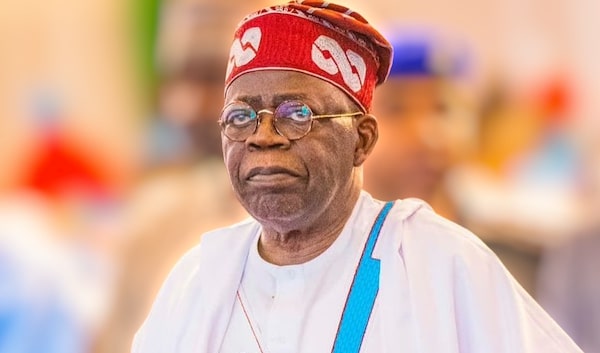
President Bola Tinubu, like his predecessor Muhammadu Buhari, seems poised to head the Ministry of Oil Resources and the newly created Ministry of Gas Resources.
On Wednesday, Tinubu assigned portfolios to his ministers, more than a week after they were vetted by the Senate.
Former Rivers Governor Nyesom Wike was appointed as FCT Minister, while Wale Edun was appointed as Finance Minister and Coordinating Minister for the Economy.
Some of the other key portfolios include Ali Pate, a professor, as Coordinating Minister for Health and Social Welfare, and Lateef Fagbemi as Federation Attorney General and Minister of Justice. Former Jigawa Governor Mohamed Badaru has been appointed Defense Minister, while former Kebbi Governor Atiku Bagudu has been appointed Minister of Budget and Economic Planning.
The president, however, did not assign any ministerial candidates to head the ministries of gas resources and oil resources. Although he has not directly stated that he intends to fill the post of oil minister, the fact that he has not appointed someone to the post indicates that President Tinubu is seeking to fill the post. His spokeswoman, Ajuri Ngelale, did not return or reply to calls or a text message sent to her on the matter.
Heineken Lokpobiri, a former Nigerian senator, was appointed Minister of State for Petroleum, while Ekperikpe Epko, a former member of the House of Representatives, was appointed Minister of State for Gas Resources.
Mr. Lokpobiri, as junior oil minister, is expected to solve the challenges affecting the oil sector, especially the problems of crude oil theft, lack of oil investments and further development of the country’s oil assets to increase revenue of the oil sector.
While Mr. Epko will work to implement the policies approved by Mr. Tinubu’s administration that are aimed at making the country use its gas potential for power generation and distribution, clean cooking, car use and industrialization.
Since taking office, Tinubu has scrapped the nation’s costly fuel subsidies, a move he promised during his campaign.
On May 29, during his inauguration as president, Tinubu announced the removal of the gasoline subsidy on which the government was spending nearly 1 trillion naira monthly.
The removal of the subsidy has caused hardship for many Nigerians with a consequent increase in the prices of goods and services.
The removal of the subsidy also led to an increase in government revenue with a total increase in distributable revenue of around N786.161 billion in May to about 1.9 trillion naira in June, when the government earned money that in the past would have been used to subsidize gasoline.
Buhari footprint
During the 2015 election period, Buhari and his All Progressives Congress (APC) party criticized the then government of Goodluck Jonathan for failing to resolve the endless crises in the country’s oil sector.
At the time, Mr. Buhari made a series of promises to Nigerians, including fixing the nation’s dying refineries, passing the Petroleum Industry (GDP) Act within a year, ending fuel imports , address corruption in the subsidy regime, among others.
ALSO READ: VAT controversy: We are waiting for the verdict of the Supreme Court – NGF
To achieve these goals, six months after being elected president in 2015, Buhari appointed himself Minister of Petroleum Resources, a move that many Nigerians say would bring transparency and accountability to the nation’s opaque oil sector.
Addressing a few select reporters in New York at the time, Mr. Buhari said: “I will remain Minister of Oil. I will appoint a Minister of State for Oil”.
Former President Muhammadu Buhari
According to him, the move was taken as part of efforts to clean up the country’s oil sector, which is said to be plagued by corruption, massive fraud and crude oil theft.
Eight years later, though the industry notably posted some gains with the passage of the Petroleum Industry Act, Mr. Buhari failed to turn around the nation’s dying refinery, among other challenges.
Nigeria’s oil sector also faced a number of challenges under his administration, including fuel shortage disruptions that caused many Nigerians to suffer, an increase in pipeline vandalism, and incidents of crude oil theft in its oil-producing region, worsened the nation’s income crisis.
Historical precedent
If Tinubu continues on this trajectory, this would mark the third time since Nigeria’s return to democracy in 1999 that a sitting president will head the country’s oil ministry.
When former President Olusegun Obasanjo was elected in 1999, he appointed himself Minister of Petroleum Resources.
During six of his eight years in office, between 1999 and 2005, Mr. Obasanjo was Minister of Petroleum and Minister of State for Petroleum. However, in 2003, the last year of his first term, Mr. Obasanjo appointed Edmund Daukoru as Presidential Advisor on Oil and Energy. Later, in July 2005, he appointed Mr. Daukoru Minister of State for Energy and Petroleum Resources.
During the Umaru Yar’Adua administration, Riliwanu Lukman was appointed Minister of Petroleum, a position he held until March 2010.
Following the death of Mr. Yar’Adua, then-former Vice President Goodluck Jonathan became acting President and appointed Diezani Alison-Madueke as Minister of Petroleum in February 2010, a position she held until May 29, 2015, when the Mr. Jonathan left office. Ms Alison-Madueke’s tenure was plagued by controversy and allegations of corruption.
Former Minister of Petroleum, Diezani Alison-Madueke
Ms. Alison-Madueke is thus the last Nigerian oil minister who is not the acting president.
In 2015, President Muhammadu Buhari followed in Mr. Obasanjo’s footsteps when he came to power and appointed himself Minister of Petroleum Resources. Mr. Buhari, during his eight-year term (2015-2023), appointed two different state oil ministers, namely Ibe Kachikwu and Timipre Sylva.
In March 2023, Mr. Sylva resigned to run for governor in Bayelsa State.
legal concerns
Public opinion is divided on the legality of the president appointing himself head of a government ministry, department or agency.
Speaking to Newslodge on Friday, an Abuja-based lawyer, Yomi Ogunsanya, argued that “it is highly improper for a president to head the oil ministry,” and the leaders behave as if they are above the law.
“Although he (Tinubu) has not announced that he will head that ministry, he is supposed to head it because of what happened during the past Buhari administration. At that time, Buhari said that he will head the Oil Ministry.
“We don’t need that now, for the president to head it and we don’t know why they can’t find anyone from all the nominees to head the ministry. It is very improper,” said Ogunsanya.
He said the president has a great responsibility to shoulder and should not be distracted by additional challenges at the Oil Ministry.
“They should strictly adhere to the law and appoint a minister to head the ministry, which is the right thing to do. So there’s someone to hold accountable. You saw what happened in the past where the ministry is not responsible for anything and whatever they have been doing.
“So the right thing to do is to comply with the law by appointing a minister to the ministry.
But Arome Okwori, a lawyer from Jos, argued that the constitution provides the basic framework for the functioning of the government machine and provides for the government’s orders.
“As per the (dictates) of the 1999 constitution of the Federal Republic of Nigeria, only the office of the Attorney General and the Ministry of Justice are specifically provided for specific and defined functions under the constitution,” Okwori told Newslodge.
“The constitution did not exclude the president in that sense, it gives the president some sort of discretion in terms of who he will appoint and to what position.
“Then you will even observe that some of the offices that were created under the Buhari administration have now been abolished under the Tinubu administration, which means it is left to the discretion of the president to decide which office to create as the ministry for his government to function well.” he added.
Okwori argued that, in strict legal language, the president cannot be held accountable for the violation of the constitution by appointing himself as a minister.
“He can decide not even to appoint the Oil Minister. If he says, look, I don’t want there to be any office like the oil minister, he can’t ask you to account for that because the constitution doesn’t say ‘to designate an office for the oil ministry.’
“Are there laws that can refer to the oil minister? Sure, there may be. But if you look strictly at the constitution, if the president, for example, wants to assume the position of Attorney General of the Federation and says look, I’m not going to appoint Attorney General and Minister of Justice. The question now will be, can he be president and also justice minister to the extent that the constitution has made specific provisions for the person to be appointed?
“I want to say, based on my opinion, that the president cannot be held accountable for holding the position of oil minister and at the same time as president,” he added.
However, the lawyer said it seems “abnormal” for the president to act as a minister.
“Is the president now saying that he doesn’t believe or trust any Nigerian other than himself? Is there something in that office that other Nigerians don’t know, that only the president knows and has the power and responsibilities to oversee?
“To me the whole idea of the president becoming a minister is pretty suspect and as you can see the government is not working well. That is my concern,” he said.
Read More Related News Here
Let hear it in the comment below if you do have an opinion on this; Like Buhari, Tinubu is likely to head the Ministry of Oil