
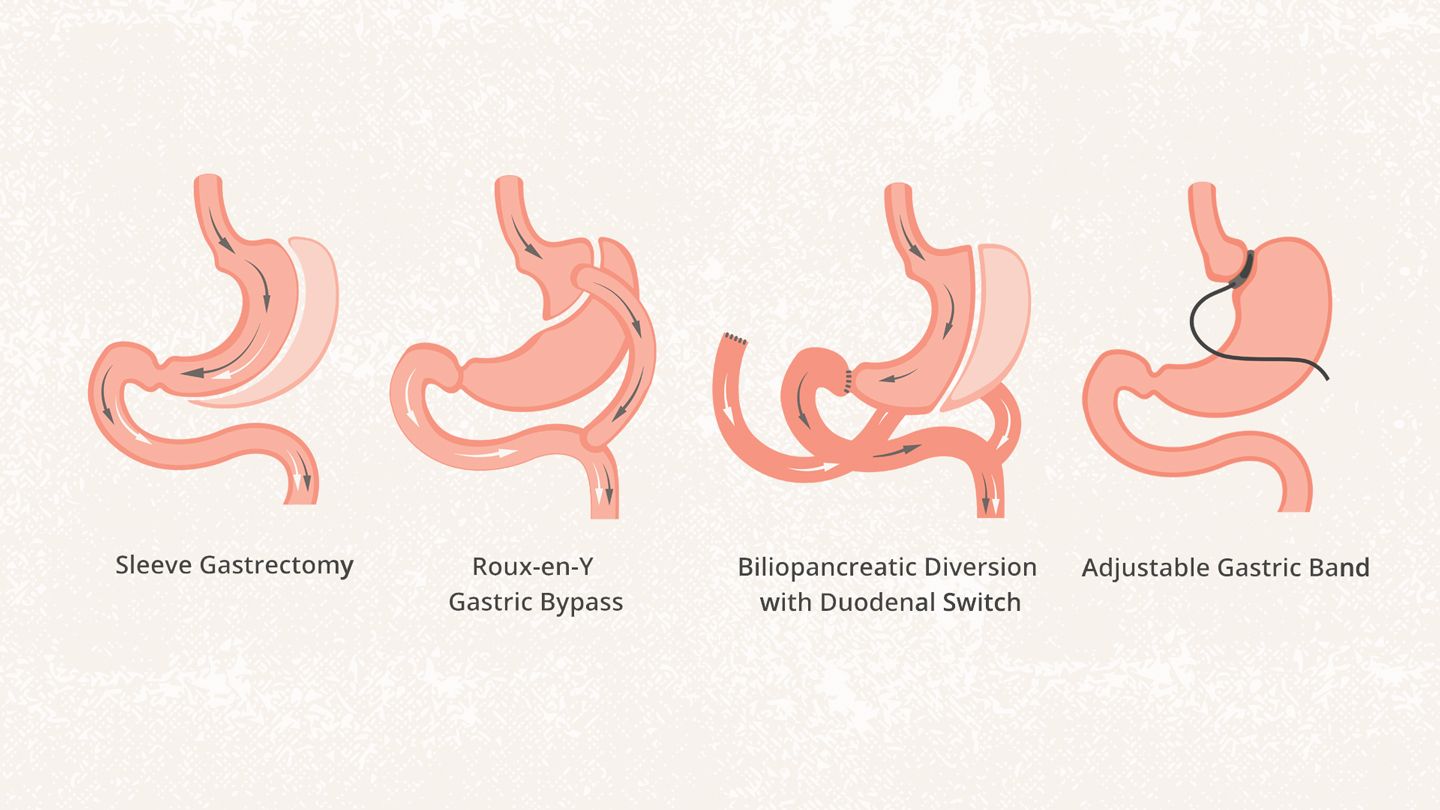
Three main types of bariatric surgery are currently performed. Although also still performed, a fourth type — adjustable gastric band — is an older and more outdated procedure that has fallen out of favor due to the development of more effective techniques, according to the ASMBS.Each surgery has pros and cons. There are different average weight loss results and potential side effects or risks, says Morrow. “In general, it seems like the risk of a procedure sort of parallels the benefits,” she adds. A sleeve gastrectomy, for example, may have a little bit less risk in some ways but results in a little bit less weight loss, while a duodenal switch has been shown to have potentially more long-term complications but also has the biggest weight loss results.Discover the low down on the three main surgeries. And note: If you’re considering bariatric surgery, you’ll want to go over each with your doctor to determine which is the best option for you.Sleeve GastrectomyThis option is the most popular kind of bariatric surgery. “Sleeve gastrectomy is currently the most commonly performed procedure nationwide,” says Morrow.The procedure involves removing 80 percent of the stomach, according to the ASMBS. What remains is a stomach that’s about the size and shape of a banana.In general, bariatric procedures work in one of two ways — or sometimes both, explains Morrow. “The first way is with restriction. All bariatric procedures have altered the stomach to try and make people have a smaller stomach and feel more full,” says Morrow. “A sleeve gastrectomy works purely through restriction, so we’re creating a smaller stomach by removing about two-thirds of the stomach, so conceptually it’s pretty simple.” The other way involves malabsorption (more on that later).A sleeve gastrectomy is the simplest of the procedures and doesn’t require as much time on the operating table. “It takes approximately an hour to perform,” says Morrow. According to the Cleveland Clinic, excess weight loss after sleeve gastrectomy can be anywhere between 30 and 80 percent.Roux-en-Y Gastric BypassMost people have heard the words “gastric bypass” but may not know its official name: Roux-en-Y gastric bypass (Roux-en-Y is French for “in the form of a Y,” according to the ASMBS).Like sleeve gastrectomy, this procedure is performed frequently in the United States. “I personally and my colleagues here at the University of Utah perform Roux-en-Y gastric bypass the most, which is kind of considered the gold standard,” says Morrow.In this procedure, the stomach is separated into a top and bottom section (the top section — also called a pouch — is roughly the size of an egg), according to the ASMBS. The bottom section is no longer used to digest food (hence the word “bypass”), and a part of the small intestine (called the Roux limb) is connected right to the new stomach pouch.“The Roux-en-Y gastric bypass works through malabsorption, so for this procedure, there is some intestinal rearrangement as well to basically alter your body’s hormonal response to food, which is important,” says Morrow. For a healthy person, malabsorption isn’t something that’s desirable, but in terms of bariatric surgery, it can be a benefit for weight loss, adds Morrow.One study explains that bariatric surgery that works through malabsorption limits the digestion and absorption of nutrients, which reduces a patient’s calorie intake, allowing for weight loss. Because vitamins and trace nutrients are also absorbed less, following the recommended diet after surgery is important to prevent unwanted side effects, the study notes.Still, unlike in a duodenal switch (explained below), not as much of the intestinal area is impacted, which results in less malabsorption. “With Roux-en-Y gastric bypass, most of your intestinal area is still available for absorption, so we see fewer malabsorptive complications with that operation, although they can happen,” says Morrow.After this surgery, according to the Cleveland Clinic, average weight loss is about 70 percent of excess body weight, and the surgery, according to UPMC, takes 90 minutes.Biliopancreatic Diversion With Duodenal SwitchThis surgery, often referred to as simply a duodenal switch, comes with the most potential weight loss, but it also has more potential risks. Per the Mayo Clinic, it’s less common. “The duodenal switch is performed in some programs, and although we aren’t doing it at this time, I think it can be a good choice for some patients,” says Morrow. Per the Cleveland Clinic, it’s especially effective for patients with type 2 diabetes.“A duodenal switch involves a bit more malabsorption [compared with the Roux-en-Y gastric bypass],” says Morrow. The surgery has two key steps, according to the Mayo Clinic. The first is to perform a sleeve gastrectomy, so about 20 percent of the stomach remains. The second step is to connect the end of the intestine — bypassing much of the intestine — to the duodenum (a tiny portion of the small intestine that connects to the stomach). This means the patient isn’t able to eat as much and is limited in how many nutrients their body can absorb. While this can lead to more significant weight loss — according to the Cleveland Clinic, excess weight loss after this surgery is 80 percent — it can create more risks, like malnutrition, per the Mayo Clinic. It also takes longer to perform, around 90 minutes to 3 hours, according to UPMC.While a specific diet is crucial for everyone who undergoes bariatric surgery, for people who have a duodenal switch, following eating guidelines closely is absolutely necessary. “They have to be really careful about eating enough protein, or else they can become protein deficient, and drinking enough water, so they don’t get dehydrated, and they have to take vitamins every day, often more than once a day depending on which vitamin supplements they choose,” says Morrow.