
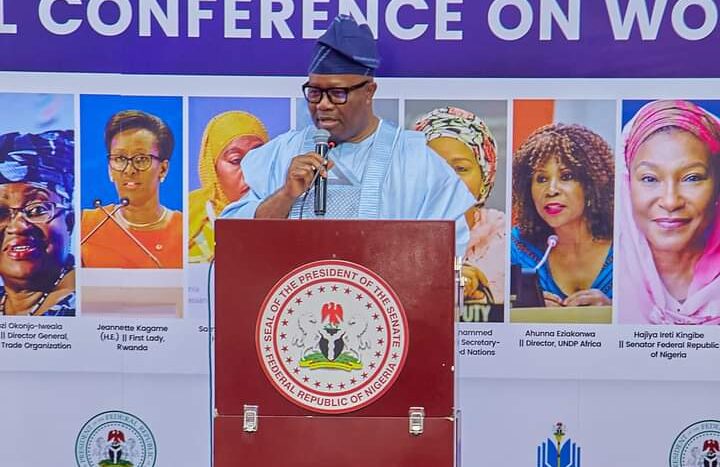
Empowering women is a necessity for Nigeria to be great, the Senate President said. Will of God Akpabiohas said.
Akpabio revealed this on Wednesday at the opening ceremony of a two-day international conference on women in government organized by the National Institute for Legislative and Democratic Studies (NILDS) in Abuja.
The President of the Senate, in a brief comment as the special guest of honor, said that his presence on the occasion represents his first official engagement outside the National Assembly since his election as President of the Tenth Senate.
Akpabio said he was committed to issues related to improving conditions for women in Nigeria, including political representation, the economy and governance.
“Those who know my background will certainly attest to my passion for promoting gender equality in all aspects of life, especially in the public sector.
“As governor, I implemented a policy that deliberately favored the appointment of women to key positions in my government. This was in recognition of the immense contribution that women make to the political, social and economic development of any state, she said.
He said that the country’s approach to the challenge of the underrepresentation of women in governance must go beyond the mere symbolic character of positions towards a genuine representation in which the voices of women are genuinely heard, valued and integrated into policies. and government laws.
“Tokenism may satisfy diversity quotas, but the true inclusion of women in political leadership will turn Nigeria’s course towards meaningful transformation and sustained growth,” he said.
ALSO READ: Nigerian Legislative Institute to Set Agenda for 10th National Assembly
According to him, women’s empowerment has five components: women’s sense of self-esteem, their right to have and determine choices, their right to have access to opportunities and resources, their right to have the power to control their own lives, both inside and outside the home; and their ability to influence the direction of social change to create a more just social and economic order, nationally and internationally.
She noted that women’s empowerment is critical, given the overall contribution of women to the Nigerian economy.
According to the IMF, the informal sector accounted for 57.7 percent of Nigeria’s GDP in 2022, making it a significant contributor to Nigeria’s economy. A 2021 World Bank report states that 80.4 percent of Nigeria’s employment was in the informal sector.
The report further shows that 82.1 percent of women in Nigeria were in the informal sector, making women the most influential force in the country, and their inclusion in governance structures is not a luxury but an opportunity. need.
Tinubu’s agenda on women’s empowerment
Mr Akpabio noted that Mr Tinubu’s “renewed hope” agenda takes women’s empowerment into account, saying the policy paper recognizes that if Nigeria is to reach its full potential, every segment of the population must be given a chance just to make your life. better contribution to the welfare and advancement of the country.
The Agenda, according to him, highlights the specific need for social inclusion and political empowerment.
He said the President will work with the National Assembly to pass a law promoting greater employment for women in all government offices, ministries and agencies to increase women’s participation in government to at least 35 percent.
“The legislation, when ready, will also oblige the federal executive to reserve a minimum number of senior-level positions for women and the private sector will also be strongly encouraged to do the same,” she said.
Akpabio noted that President Tinubu has already achieved some milestones: women make up around 20% of the newly inaugurated cabinet.
Although this falls short of 35 percent affirmative action, she said it was significantly improved over the previous cabinet, which had 15 percent women’s representation.
“In the coming months and years, the National Assembly will work closely with the President to achieve the noble goals outlined in his Agenda.
“As everyone knows, the result of the 2023 general election, in terms of the number of women elected to various positions, shows that more work is needed and that previous efforts have not brought the desired results, she said.
On economic empowerment, she said the Senate will work with Tinubu to ensure that commercial banks support women-owned businesses through concessional loans and incentive schemes.
Other areas of possible collaboration with the executive, he pointed out, include the fight against domestic violence and abuse through specialized police units, the promotion of educational parity between girls and the improvement of the conditions of disadvantaged women through programs of social intervention.
He pointed out that these and other political positions of the executive will be incorporated into the Legislative Agenda of the Tenth Senate with specific legislative actions and schedules to achieve them.
“I want to affirm that the Senate will work with all interested parties to achieve the necessary constitutional and statutory reforms to promote the political participation of women. I accept all suggestions, which should be submitted as memos to my Office.
In his keynote address as organizer of the conference, NILDS Director General Abubakar Sulaiman lamented the severe underrepresentation of women in governance at both the national and subnational levels of the country.
Mr. Sulaiman, a professor, noted that the Inter-Parliamentary Union (IPU) ranks Nigeria among the bottom 10 countries in the world for women’s representation in national parliaments, and said the overall picture is worrying, considering that women Women make up almost fifty percent of our population and contribute significantly to the economy and political processes, especially elections.
At the executive level, he said, “the percentage of women in ministerial positions since the start of the Fourth Republic in 1999 has not exceeded 30 percent (31.7 percent under Goodluck Jonathan in 2011). Of the recently sworn in federal ministers, only 19% are women.
The Director General said that the downward trend has continued despite the provisions of the National Gender Policy that 30 per cent of elective and appointment posts be reserved for women.
Many other official documents and declarations by governments and political parties set out policy and regulatory frameworks to achieve gender equality and inclusion, in addition to the constitutions and manifestos of all major political parties, including specific provisions on women’s representation.
He noted that recent legislative proposals to provide a legal framework for affirmative action and gender quotas failed to pass in the National Assembly.
According to him, the five bills were intended, among other things, to provide 35% affirmative action for women in the administration of political parties and reserve 15% of seats in the House of Representatives for women, expand the scope of citizenship through registration, extending citizenship to foreign spouses of Nigerian women, and securing a reserved quota for women in executive cabinet positions (ministers and commissioners).
The contribution of the NILDS to deepening the representation of women in governance
Sulaiman said the conference was in line with the institute’s mandate to deepen democratic culture and promote political participation and inclusion. According to him, NILDS has been at the forefront of advocating to deepen women’s participation in the country’s political process.
“We have consistently collaborated with partners, including UN Women, to advance this mandate,” she noted.
Since its creation in 2011, the Director General noted that the institute has conducted a gender audit of the National Assembly and has developed a gender mainstreaming manual for the Nigerian legislature.
She noted that the institute’s Strategic Plan (2019-2023) explicitly outlines its commitment to promoting a gender-responsive legislature in Nigeria and fostering gender equality.
“In line with this, we have generated and published numerous research studies that respond to the needs and interests of women in government structures, operations, methods and work processes.
“The Institute has also consistently invested in capacity building for female candidates, women members of the National Assembly and State Assemblies, and other interested women. Over the past two years, we have intensified the promotion of gender budgeting to ensure that public resources are used to increase gender equity.
Some of the dignitaries who attended the conference, in addition to Mr. Akpabio, included the Vice President of the Senate, Jibrin Barau; the Speaker of the House of Representatives, represented by Kafilat Ogbara; the Minister of State for Labor and Employment, Nkeiruka Onyejeocha; the former First Lady of Ekiti State, Bisi Fayemi, who was one of the keynote speakers; and former Senator Abiodun Olujimi.
Also in attendance were women parliamentarians from Uganda, Kenya and South Africa, gender activists and university academics, among others.
Read More Related News Here
Let hear it in the comment below if you do have an opinion on this; For Nigeria to be great, women must be empowered: Akpabio