
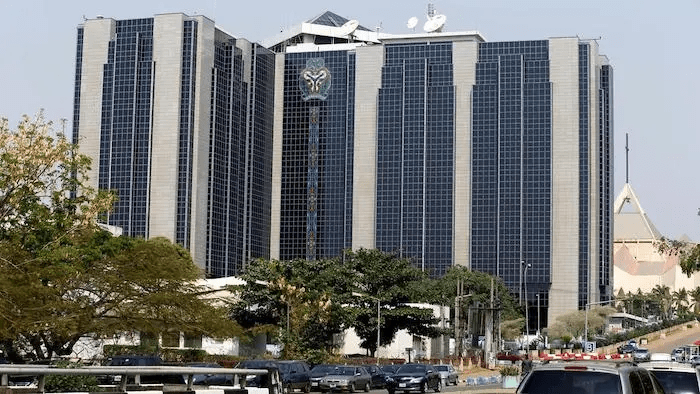
The Central Bank of Nigeria (CBN) securities lending of JP Morgan and Goldman Sachs could send Nigeria’s credit rating freefalling to junk amid efforts to reposition the economy.
The main bank, in its recently released 2022 financial reports, reported borrowing $7.5 billion from US banks. JP Morgan and Goldman Sachs by pledging securities.
Analysts say the loan deal, which the central bank says was arranged “in exchange for its securities being held as collateral,” may hurt the nation’s fragile fiscal position and credit rating.
JP Morgan
The CBN also disclosed that it entered into 30-day forward contracts totaling 3.15 trillion naira in 2022 with undisclosed counterparties.
Sylvester Anaba, an analyst at a Lagos investment house, told Newslodge that there will be no serious consequences as CBN can pay off its debt to these foreign creditors.
“But if they default, investors will start dumping our bond. It will also affect our credit rating,” he said.
“Recently, some ratings went up and Nigeria remained at B-, about six notches below junk. Means by the time CBN defaults; there is nothing that saves us from going into scrap metal”.
The major bank’s disclosure on loans of $7 billion and $500 million, respectively, from JP Morgan and Goldman Sachs leaves fragile investor confidence in Nigeria in danger of further damage after the president’s series of currency reforms Bola Tinubu and the termination of a regime of costly fuel subsidies that international investors are already recovering.
ALSO READ: Why Nigeria’s inflation rose in December after an eight-month slump: Analyst
Ratings agency Fitch last November downgraded Nigeria’s long-term foreign currency issuer default rating (IDR) to ‘B-‘ from ‘B’, citing “deteriorating government debt servicing costs of Nigeria and external liquidity despite high oil prices”.
Goldman Sachs
A verdict by New York-based Moody’s Investors Service earlier this year similarly cut Nigeria’s ratings to non-investment grade, jeopardizing its prospects of raising debt on the international capital markets. Then-Finance Minister Zainab Ahmed rejected Moody’s position.
“But these are external rating agencies that don’t have a full understanding of what’s going on in our home environment,” he said in a rebuttal.
In the context of recent reforms, S&P Global Ratings revised its outlook on Nigeria to stable from negative in early August.
“Nigeria’s newly elected government has moved quickly to implement a series of fiscal and monetary reforms, which we believe will gradually benefit public finances and the balance of payments,” the ratings agency said in a statement.
Analysts are concerned that the various disclosures in CBN’s recently released financial reports could reverse the gains of the past few months.
Such a high undocumented exposure on the country’s public debt books is an early setback for recent moves such as Nigeria’s multiple exchange rate unification, aimed at stabilizing the naira.
Nigeria’s dollar bond due 2030 sank 2.295 cents to its lowest in a month on Friday at 83.221 cents as a crisis of confidence in the economy among investors deepened.
“We are currently dealing with a confidence crisis in the foreign exchange market. This can make the trust problem even worse. It could aggravate speculative activities,” said Muda Yusuf, executive director of the Center for the Promotion of Private Enterprise.
“The rating agencies are going to start reviewing our ratings. You know what that will do to our reputation as a country,” Dr. Yusuf further said.
more irregularities
CBN’s books for 2022 showed $3.2 billion is owed to an unidentified portion as foreign currency forward contract payables; there are no notes providing clarity on the transaction accompanying that item.
“Since the loans from JP Morgan and Goldman Sachs etc. are collateralized with foreign assets (securities) from Nigeria, then the current gross foreign reserves of around $30 billion become $16.3 billion net” , a leading economist who sought anonymity told Newslodge.
“If the other outstanding obligations are included, CBN is technically insolvent,” he added, noting that the exchange rate is likely to depreciate further.
The analyst remarked that the low levels of real reserves have made it difficult for the central bank to intervene in the foreign exchange market.
The current state of the reserves means that investors will prefer to accept the exchange rate as it is at the moment knowing that the reserves could be depleted soon.
“The race for the exit door will create a stampede in the currency market,” the analyst said.
International investors’ decision in 2021 to abandon dollar-denominated open market operating (OMO) bills was meant to strain reserves with foreign investment in the bills already at $17 billion a year. before.
According to the analyst, “it was at that time that CBN took out guaranteed loans from these banks.”
The immediate former president, the CBN board of directors and the National Assembly failed to get Godwin Emefiele, the central bank governor, to register a mark of lack of supervision, making them guilty, he added.
Godwin Emefiele, Suspended Governor of the Central Bank of Nigeria (CBN). [Image sourced from CBN Twitter account]“While they don’t have to approve CBN’s transactions, they didn’t penalize the governor for not publishing or publishing the annual reports, which would have exposed the scam.
“Entities that lent money to CBN have violated an important international standard: if a country’s law requires published audited accounts, they violated the law by lending to an entity that broke the law,” the analyst said.
“The IMF should be asked questions: CBN received IMF advances in 2020, which Annual Report formed the basis? What safeguards were in place before the money was advanced? “Why have the IMF annual reports since 2016 not pointed out these problems? Can the IMF be trusted as a credible and impartial organization?” he said.
Opacity
Last year, Newslodge expressed concern about the failure of the main bank to publish its financial reports in flagrant contravention of existing laws.
For years, the Central Bank of Nigeria (CBN) repeatedly failed to publish its annual reports showing details of its operations and financial obligations.
Since 2005, when it started publishing the details of its annual report on its website, CBN never stopped publishing the report until it stopped publishing the crucial documents shortly after the Muhammadu Buhari government came to power.
Central Bank of Nigeria (CBN)
In accordance with the CBN Act of 2007, the main bank is expected to publish its report within two months after the end of each fiscal year.
“The Bank shall, within two months following the close of each fiscal year, transmit to the National Assembly and the President a copy of its annual accounts certified by the Auditor,” the CBN Law says in part.
“The Bank will publish a report that must be presented to the National Assembly and the President in the manner indicated by the Governor.
“The Board shall ensure that the accounts submitted pursuant to this section are published as soon as possible in the Gazette.
“The Bank shall, as soon as possible after the last day of the end of each monthly compounding, publish a return on its assets and liabilities as of the close of business on that day, or if that day is a holiday, the close of business of the last previous business day”, says the Law.
Analysts said CBN’s failure to publish the report sent the wrong signals to investors and others interested in understanding the state of the economy and hid Nigeria’s fiscal problems for too long.
Read More Related News Here
Let hear it in the comment below if you do have an opinion on this; CBN’s $7.5bn Loans From US Lenders Hurt Nigeria’s Credit Rating