
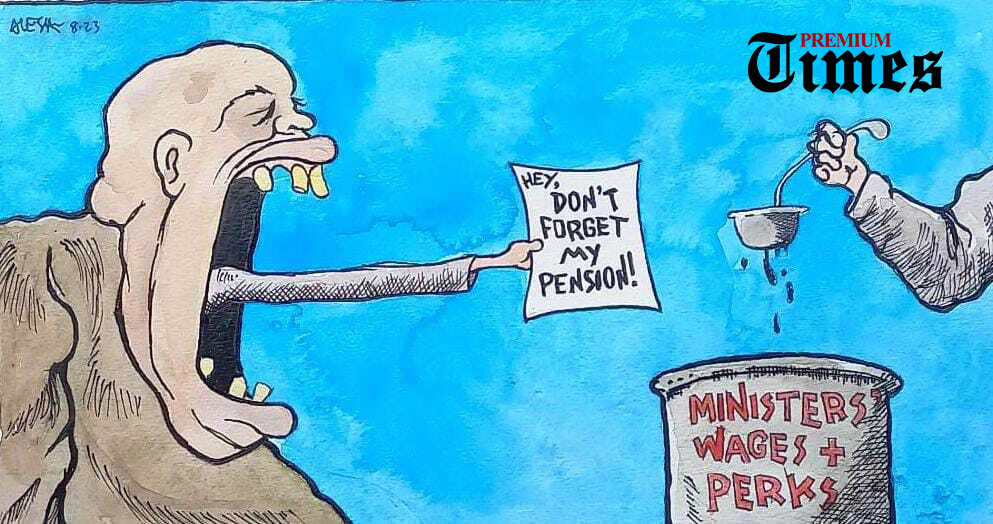
Lifetime pension packages for former state governors have been a controversial issue since 2007, when the first batch of Fourth Republic governors served out their eight-year terms. This is a new low in public morality or governance, which has drawn a great deal of criticism from Nigerians. It is not only hateful but also a serious violation of the Nigerian Constitution. What makes it even more disgusting is the fact that there are around seven out of eight former governors in President Bola Tinubu’s cabinet, who are enjoying this obviously undeserved reward and, at the same time, will receive salaries as serving civil servants.
Ironically, the president is one of them. As governor of Lagos state from 1999 to 2007, his administration was the first to chart this unpopular political course, which has now spread to more than half of the federation’s 36 states. This is despicable. As a result, the president should show leadership by denouncing him to serve as a moral compass for his ministers. That they receive double emoluments at the expense of the suffering Nigerian masses, thousands of retirees and unpaid workers in their respective home states, is a gross display of callousness.
He Socioeconomic Rights and Accountability Project (SERAP) got it right when it recently criticized these former governors. He drew the president’s attention to the public interest he arouses and advised him to stop the scandal. The ministers entangled in this moral skein are: Nyesom Wike, Adeboyega Oyetola, Atiku Bagudu, David Umuahi, Ibrahim Geidam and Simon Lalong. Bello Matawalle is not involved, as he instigated a measure that repealed the Governor’s Pensions Act by the Zamfara State House of Assembly as Governor in 2019.
The fact that some states have repealed their pension laws, others have avoided them altogether, and that some former governors of states where the law exists refuse to accept these benefits should have raised moral qualms in those who still receive these pensions. As SERAP highlighted, if new ministers collect such life pensions, while claiming to be serving the public interest, it says a lot about their conduct and integrity.
It is instructive that the pension benefits of former governors go against constitutionalism and good conscience. The 1999 Constitution, as amended, stipulates that a pensioner in Nigeria must have worked for at least 10 years. However, this wicked entitlement is intended for a select group who spend between four and eight years in public service. Besides Zamfara, Imo is among the few states that have repealed their dishonest pension laws. More should do the same, enamored of the hackneyed position of our basic rule that any law that is inconsistent with the Constitution is null and void to the extent of its inconsistency, and of no effect.
Lagos State kick-started this noxious ball in 2007 with a law providing a lifetime pension for the former governor at the rate of 30 million naira per year; a house in Lagos and Abuja for those who served two terms; six new cars every three years; free medical care for him and his relatives; and a retinue of domestic servants. Successive governors after the class of 2007 have upped the ante, evident in the 300 million naira pension benefits for a former governor in Gombe State. Godswill Akpabio, as Governor of Akwa Ibom State, signed a pension law providing an annual benefit of 200 million Naira to a former Governor.
In 2017, the treasuries of 21 states had been stripped of 37.4 billion naira as pension payments to 47 former governors. In this mix is their spending of billions of naira on security votes, which are not counted while they are in office. And as one of them once admitted, no ex-governor is poor, given the perks of office that he enjoyed while in office for at least four years. The president and ministers should quickly respond to this public desire. To act otherwise will be emblematic of callousness and greed.
…Public office is for public service, not for personal enrichment
Finally, last week President Bola Tinubu inaugurated 45 ministers, out of his planned 48-member ministerial team. He urged them to be squires in carrying out his Renewed Hope agenda. In a clerical tone, the president insisted on transparency, accountability and integrity as fibers of good governance, amid high expectations from Nigerians. Newslodge believes that it has no choice in this regard!
ALSO READ: SERAP to Tinubu: Prevent Wike, Umahi and other ministers from collecting pensions as former governors
Their jobs are clearly well prepared for the mountain of challenges they face: the economy is in tatters, which is quite evident in the rising daily cost of living that has become a nightmare for most Nigerians. Insecurity remains an ever-present danger, exemplified by the recent massacre of 26 soldiers in the state of Niger at the hands of terrorists, while the health sector and education systems are in a sorry state. Nigeria’s crude oil is largely stolen, while what little oil revenue comes in is plundered, just as abandoned projects litter the landscape, exemplified by the scam that the Niger Delta Development Commission has become ( NDDC).
These absurdities stem largely from the lamentable failure of successive ministers to perform in a credible manner. What the country desperately needs is a redemption song in these areas and much more. And only ministers who understand their responsibilities can play the symphony. In plain terms, the essence of public office is service, not self-aggrandizement.
Unfortunately, the latter is often the case in Nigeria. In the past, many ministers have been caught up in the web of criminal abuses of office, including phony contracts, cronyism, contract splitting, taking bribes, flagrant disregard of the Fiscal Responsibility Law, and nepotism. This explains why the records of the Economic and Financial Crimes Commission (EFCC) are full of files on corrupt practices by former ministers.
It is ridiculous that many of these cases have been languishing in the courts for a decade or so, blocked by corrupt members of the judiciary and lawyers. Ministers’ penchant for bribery, as was evident in the case on Sunday Afolabi, a former police affairs minister, was revealed in the $214 million SAGEM contract in 2003, under the administration of President Olusegun Obasanjo. He was imprisoned and prosecuted along with his henchmen. Some former ministers have fled the country to avoid prosecution or have secured senior positions that grant them immunity from prosecution.
As a result, it is incumbent on all Nigerians to be part of the watchdog bodies of these ministers. The situation in which the country currently finds itself is similar to a state of war or emergency, which leaves no room for chance. A sure way to corral ministers on the right track is for the president to have performance indicators and delivery schedules for each of them. President Tinubu should act like Obasanjo, if any of them fail; and not like his distant predecessor, Muhammadu Buhari. Homilies, as he delivered at his inauguration, simply cannot replace the application of closely monitored performance indicators.
Read More Related News Here
Let hear it in the comment below if you do have an opinion on this; The illegality of ex-governors receiving both salaries and pensions as ministers