
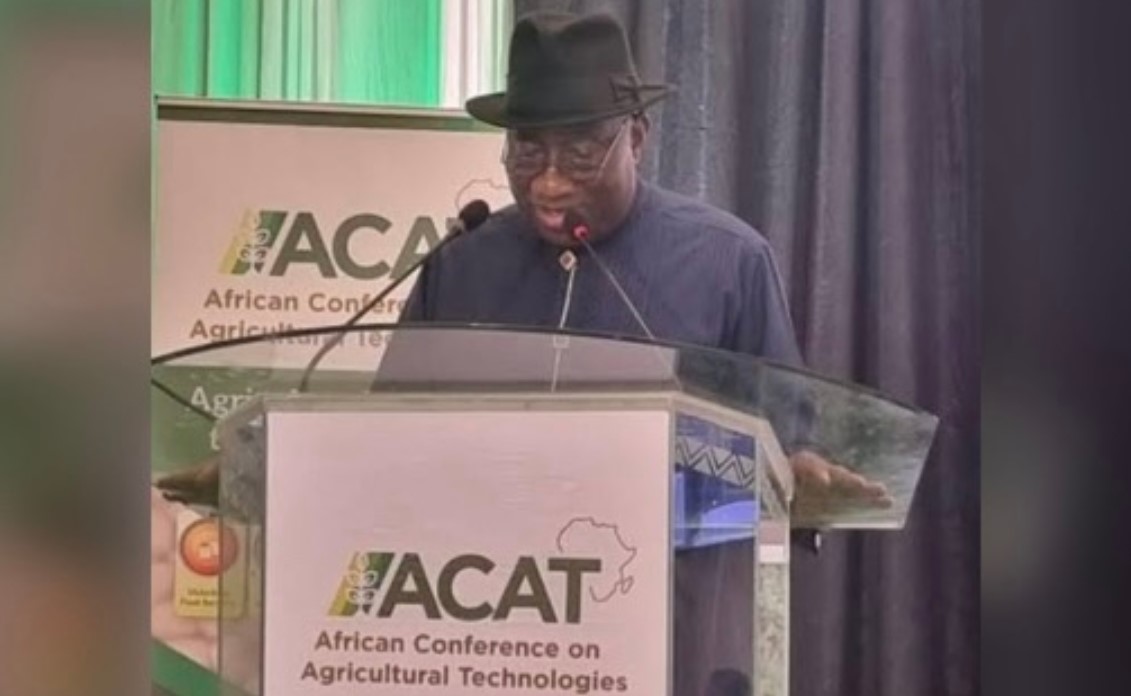
Former Nigerian President, Goodluck Jonathan, emphasized the need for political will, investment, and commitment to ensure the welfare of people and to prevent hunger. Speaking at the African Conference on Agricultural Technologies (ACAT) in Nairobi, Kenya, Mr. Jonathan called on African leaders to embrace technological innovations to boost their agricultural sector and achieve self-sufficiency in food production. Jonathan, who is also an African Agricultural Technology Foundation (AATF) Ambassador for Agricultural Technology, stressed that technology can play a vital role in promoting agricultural resilience and food security in the continent.
The former Nigerian leader said Africa, home to over 60 percent of the world’s arable land, was grappling with food insecurity and the vagaries of climate change, including pests and diseases.
“We cannot continue like this, as we must, as a necessity, match the inherent and abundant resources on the continent with agricultural prosperity with no one left in hunger. Innovation is the bedrock of all evolutionary transformative change,” Mr Jonathan explained. “Africa must rapidly evolve by embracing innovation to foster resilience in its agricultural endeavors.”
He added, “Innovation must be part of our resolute course to reshaping our agricultural outlook that should help our farmers to ably adopt new approaches to effectively withstand or overcome the myriad of challenges that currently bedevils the sector. It is by being creative and innovative that we as a people and a continent can bestow on ourselves a well-secure food, nutrition, and economic prosperity.”
Mr Jonathan urged African nations to invest in research and development and integrate cutting-edge science in developing advanced innovative technologies to enhance precision agriculture, biotechnology, and digital platforms that connect farmers with knowledge and skill from planning through production to markets.
“These innovations empower our farmers, improve yields, and boost income,” he said. “We must provide quality, effective extension services to ensure that our farmers are equipped with the skills and knowledge to effectively utilize these new technologies. The youth, in particular, must be encouraged to see agriculture as a viable, modern, and profitable career.”
He also called for partnerships among governments, the public and private sectors, non-governmental organizations, research institutions, farmers, community groups, and other stakeholders for agricultural development.
“It requires political will, investment, and a commitment to the welfare of our people. It’s about ensuring that no one goes to bed hungry and that the efforts of our hardworking farmers are rewarded,” Mr Jonathan stressed.
(NAN)