
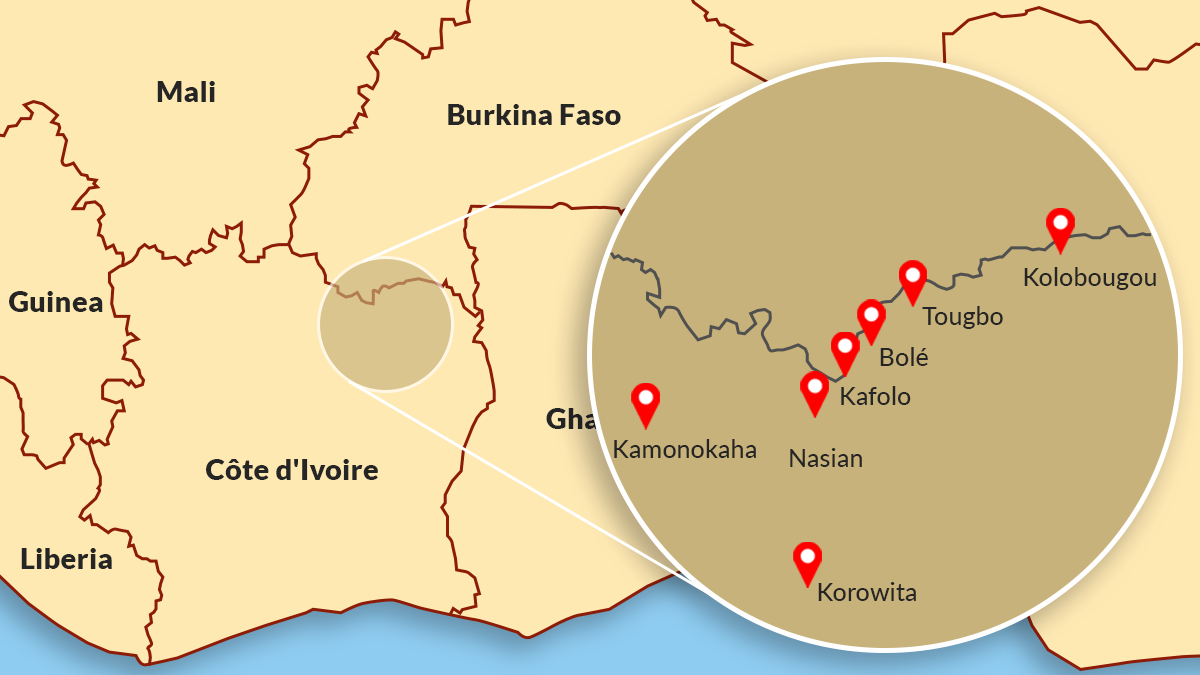
Although northeast Ivory Coast has experienced a period of relative calm following an increase in terrorist attacks in 2020 and 2021, violent extremists are still active in southern Burkina Faso.
The Institute for Security Studies (ISS) has revealed that the region has provided terrorist groups with the means to finance, recruit, and supply, highlighting a dimension of the threat that requires greater attention. These activities were particularly evident in relation to the livestock economy and illegal gold mining.
Extremist groups have capitalized on the insecurity they create by providing protection to citizens in the Bounkani and Tchologo areas where they operate or exert influence, particularly along the border with Burkina Faso. It is crucial that these activities are addressed to ensure safety and security in the region.
Many ranchers, breeders, shepherds and traders collaborate with these groups to prevent militants from confiscating their animals. Those unwilling to do the same have no choice but to leave the area or face being victims of cattle rustling, intimidation, threats of violence or kidnapping.
Using these tactics, violent extremist groups have engaged in livestock farming and trading in parts of Bounkani and Tchologo. The ranchers who obey the militants will be able to continue with their work. But in addition to being forced to collaborate with extremists, they have to pay them an annual contribution in cash or in kind (oxen).
This allowed armed groups to generate livelihoods and income and expand their networks of “trading partners” in the livestock trade, including informants, recruiters and couriers.
The ISS investigation also revealed the groups’ involvement in artisanal gold extraction, especially in the Comoé National Park and the Comoé River. As in the livestock sector, these activities were based on offers of “protection” or “authorization” for illegal miners to continue their activities.
Miners and traders along the Comoé River have reported that violent extremists have formed agreements with mining “bosses” who finance or manage mining activities. However, in the Comoé National Park, these groups have resorted to confiscating gold from miners through coercion. The militants have also actively searched for gold in the park using mineral detection devices. In some cases, members of the terrorist group have acted as financiers for artisanal gold mining operations, with intermediaries offering financial support to continue mining activities.
Northern Ivory Coast has become a settlement for militants due to various factors. The lack of essential services such as roads, schools, water, and healthcare, coupled with a weak state presence, has made residents feel abandoned. As a result, they have resorted to alternative means of earning a living to care for themselves and their families. Additionally, the livestock trade and artisanal mining are not sufficiently regulated, allowing terrorist groups to infiltrate the market and establish themselves as “protection” providers. The porous nature of the borders has also facilitated access in and out of the country for militants, traffickers, and smugglers of all kinds.
Despite the government and others efforts In recent years to address insecurity, including military and social interventions, most vulnerabilities persist.
Extremist groups need financial, human, logistical and operational resources to function. As long as they remain active in southern Burkina Faso, it is unlikely that they will stop trying to mobilize these resources in northern Côte d’Ivoire.
That means Ivory Coast authorities and their bilateral and multilateral partners who are helping to prevent the spread of violent extremism must consider this dimension of the threat. Attention must be paid to illicit cross-border economies and the factors that enable them. Understanding and addressing the mechanisms that terrorist groups use to benefit from or shape these economies could limit their ability to operate and expand.
Continued government efforts are necessary to regulate artisanal gold mining, and cooperation with organizations representing the livestock economy is crucial for successfully implementing regulations in the sector. It is important to increase awareness of laws governing livestock movement and grazing areas.
In order to combat the cross-border nature of violent extremism and the financial support provided by extremist groups, cooperation between Côte d’Ivoire and neighboring countries is essential. This requires not only military and security operations, but also improvements in governance and development in shared border areas.
William Assanvo, Senior Researcher at the Institute for Security Studies (ISS) Regional Office for West Africa, the Sahel and the Lake Chad Basin, emphasizes the importance of addressing these issues. This article was originally published by ISS Today, a distribution partner of Premium Times, and we have permission to republish it.