
“What Young People Want”, a massive survey project conducted by PMNCH – a global alliance for the health and well-being of women, children and adolescents, organized by the World Health Organization – reports interim results today through a public board released on the eve of the United Nations International Youth Day 2023 on August 12.
The survey asks young people aged 10-24 to express, in their own words, what they want most for their own well-being, giving a voice to many who have simply never been asked, even in low-resource and fragile settings. . .
Among the 713,273 respondents aged 10-24, the main interest expressed by young people (40.5%) is learning, competence, education, skills and employability (40.5%), reflecting a strong interest in job stability, economic and material security and independence. .
This result was reflected across all age groups, particularly those aged 15-19 (47.2%) and adolescent girls (49.2%), who frequently cited the need for “learning opportunities” and “quality education”.
In 2022, in low- and middle-income countries, learning losses from school closures due to COVID-19 left up to 70 percent of 10-year-olds who cannot read or understand simple text, up from 53 percent before the pandemic.
In parallel, the increase in conflicts around the world has left many young people unable to participate in the labor market, including as a result of low levels of education, physical and psychological conditions, and a shortage of vocational education and training. Climate change also presents an imminent challenge to economic well-being, with an estimated 60% of young people around the world who currently lack the necessary skills to support the ‘green transition’.
The PMNCH aims to obtain responses from a total of at least 1 million young people by October 2023, when it will convene the Global Forum for Teens – a virtual gathering and the world’s largest event to date focused on adolescent well-being, driving the 1.8 Youth for Change Campaignreleased in October 2022.
Real-time needs of an ignored population
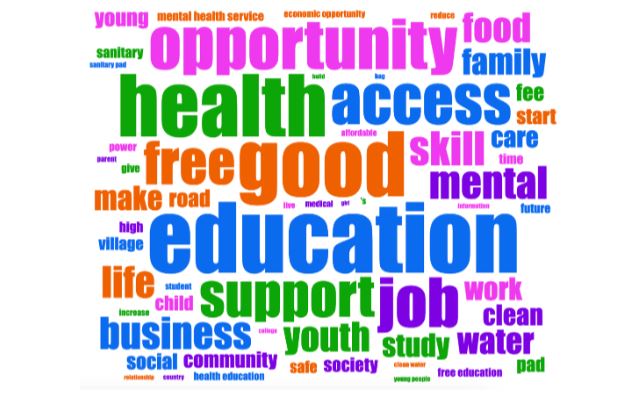
The survey is based on a simple but powerful question: “To improve my well-being, I want to…”. Young people are asked to use their own words to express their ideas, and respondents choose the words that appear most frequently, including: “education”, “health”, “school”, “opportunity”, “work” and “access”. The most frequently chosen phrases included ‘mental health’, ‘good health’, ‘good education’, ‘reproductive health education’, ‘learning opportunity’ and ‘job opportunity’.
Young people in low- and middle-income countries have been among the hardest hit in our increasingly fragile world, including pandemic-based disruptions to school education, household food insecurity and low income, rising mental health problems, the cost of living crisis and the deepening impact of climate change.
For those with the right knowledge and tools, youth leaders and influencers can be heard through social media. But for many others, their voices remain unheard. Those who master the policy and investment tools are left uninformed and unable to access meaningful evidence. “What Young People Want” seeks to change that.
“What Young People Want has empowered us to break the silence and raise our voices for a better future,” said Saksham Parimal, an activist with the 1.8 Billion Youth Campaign for Change and a Political Engagement Fellow at the YP Foundation in Bihar, India. . .
“We no longer feel overlooked or ignored. This campaign has given us the platform to demand action on issues that matter to us and our community. Together, we are forging a path towards positive change, ensuring that our health and well-being are a priority. We are the architects of our future, and with What Young People Want, our dreams are becoming a reality,” she said.
The survey uses digital technology and face-to-face outreach through teams of trained youth mobilizers to collect responses on a large scale.
A WhatsApp-based chatbot allows smartphone users to quickly and easily register their responses by scanning a QR code. Users without smartphones and little or no access to technology can register their responses through the campaign’s 1.8 youth mobilizers active at the community level in over 20 participating countries in Africa, Asia and Latin America, including Nigeria , Uganda, Zambia, Malawi, Ghana, India, Indonesia and others.
Once the data has been entered, an algorithm rapidly assesses and classifies each response into one of five main “domains” informed by a conceptual framework on adolescent well-being developed by UN agencies with PMNCH. The framework organizes and categorizes various needs of adolescents, assessed through extensive research and community outreach work, and highlights the interdependence of health and nutrition, education, safety, resilience, and positive values in producing well-being. .
key results
Other common needs and concerns expressed by youth included “safety and a supportive environment” (cited by 21.2% overall) and “good health and optimal nutrition” (16.3%).
Younger respondents had specific concerns: 11.0% of respondents ages 15-19, 8.4% of ages 20-24, and 1.8% of ages 10-14 cited the need of “safety and a supportive environment”. Teenage boys want “clean water” and “good roads”, while teenage girls added “free sanitary napkins” to the list in addition to “clean water”.
Overall, almost half of the respondents (47.2%) were between the ages of 15 and 19, with 25.7% girls and 21.5% boys.
Among these, the average age is 16 years, which represents 13% of the total respondents. The group of youngest adolescents (10 years old) was the least represented with 1.2%, while the group of older adolescents and young people, aged 24, concentrated 7.3% of those surveyed.
Approximately 1% of respondents identified as trans men, trans women, gender fluid, two spirit, non-binary, agender, other, or preferred not to say their gender.
More than two thirds (68.8%) of the respondents came from the Africa region, followed by the Southeast Asia region with 27.5% and a small minority from Latin America. The scope of the survey to date has prioritized low- and middle-income countries, ensuring that less frequently heard voices are prioritized. Future outreach will expand to high-income countries.
India constituted the largest population of respondents, comprising 17.2% of the total sample. Uganda ranks as the second largest contributor at 12.0%, followed by Indonesia at 10.2% and Zambia at 8.4%.
Action Agenda for Adolescents
Real-time results are available through the Digital board of what young people want, which allows users to analyze data and trends by topic, gender, age, and country. The Dashboard is an open access public tool for students, young change makers, national legislators and journalists seeking to understand and address the demands of youth nationally and globally. Dashboard data is collected directly from survey responses and is not drawn from official country statistics or data sets.
Globally, PMNCH will bring together the findings of the What Young People Want survey into a “Teen Action Agenda,” to be unveiled at the Global Teen Forum on October 11-12, 2023.
“The Global Forum for Adolescents will be a key milestone for the 1.8 Billion Youth for Change campaign, bringing together youth and adolescents, advocates, world leaders and decision-makers at a crucial time to drive policy change and redesign of programs worldwide. country level,” said Helga Fogstad, Executive Director of PMNCH.
“Adolescence is a critical stage of development with positive outcomes not only for adolescents but for people of all ages. Ensuring the well-being of adolescents is critical to achieving a sustainable future for all, which requires intersectoral approaches that respond to the multifaceted nature of their development. The effort made to ensure the well-being of adolescents today, especially for women, will generate a triple dividend for adolescents now, in their future lives and for generations to come.
Read More Related News Here
Let hear it in the comment below if you do have an opinion on this; What young people are demanding in response to high cost of living, pandemic disruptions, climate crisis, conflict