
Samsom Odeyemi fondly recalls being a successful farmer in his home community of Itajirin in the Ogere Remo area of Ogun State. Odeyemi earned millions of naira annually on his 15-hectare farm where he grew rice, vegetables and pepper. All of that was lost about six years ago, when gasoline began leaking into the farm from a ruptured pipeline in the Nigerian National Petroleum Corporation (NNPC), now the Nigerian National Petroleum Company Limited.
Pollution quickly destroyed the farm and Odeyemi now makes a living selling water in the community.
samson odeyemi
It was the same experience for Senanou Yaovi, whose seven-hectare maize and pepper farm was destroyed by fire after an oil spill about five years ago, and for Solaru Oluwole, a mother of five, whose farmland was also devastated. by a forest fire in April 2018. after it was contaminated by gasoline.
In Itajirin, many others also gave up farming after oil spills destroyed their farmland. However, the experience is not exclusive to the Ogun State community.
The road to Itajirin community in Ogere Remo area of Ogun State Intractable problem
Between 2015 and 2022, the Nigerian National Oil Spill Detection and Response Agency (NOSDRA) Recorded 4,440 oil spills combined. Spilled contents (often crude oil but in some cases, such as in Ogun State, refined products such as gasoline) totaled 208,406,603 barrels. In other words, around 1,257 tanker trucks loaded with petroleum products were dumped into the environment. Many farmers, like Mr. Odeyemi, Mr. Yaovi and Mr. Oluwole in Itajirin, have felt the direct impact of oil spills on their livelihoods.
Nigerian National Petroleum Corporation (NNPC) group chief executive Mele Kyari recently said that the oil company loses around 200,000 barrels of oil daily due to pipeline vandalism. The data also indicates that, aside from economic sabotage, commercial farmers bear the brunt of crime.
About 850 pipeline points were vandalized between 2015 and 2018, according to data from the NNPC’s Monthly Financial and Operations Report (MFOR). The monthly financial report also indicated that 1,161 pipeline points were vandalized across the country between January 2019 and September 2020.
Five pipeline hubs between Port Harcourt, Mosimi-Ibadan, Gombe, Kaduna and Warri-River Niger were vandalized between January 2019 and September 2020. The Port Harcourt pipeline hub recorded the highest proportion of points damaged, with 538 points affected.
It is closely followed by the Mosimi-Ibadan axis with 535 damaged points. 46 pipeline points were damaged in Gombe, 32 in Kaduna and 10 in Warri-River Niger.
Nnimo Bassey, executive director of the Health of Mother Earth Foundation, said a few thousand barrels of oil can destroy about 20 hectares of land. Bassey, whose foundation focuses on issues affecting the environment, stressed that if oil spills persist in an area, they can lead to food insecurity.
He Food and Agriculture Organization of the United Nations (FAO) had projected that around 2.5 million people in Nigeria would face acute food insecurity during the lean season from June to August 2023. A quarterly report released by the global organization shows that the projected figure is higher. to the 19.45 million expected in 2022.
The situation has been aggravated by oil spills.
Ms Oluwole told this journalist that the supply of cassava, yams and vegetables has decreased in the Ogere area of Ogun State in the last five years.
“We no longer have enough yams, vegetables and cassava on the market because many people have given up farming as a result of the oil spill,” he said.
Oil spill
An NNPC pipeline runs through the Wasan, Oke-pakala, Akonko, Shakara, Belefun and Obelu areas of Ogere Remo, Ogun State. These communities are largely dominated by farmers and fishermen, but oil thieves frequently vandalize pipelines to divert oil products.
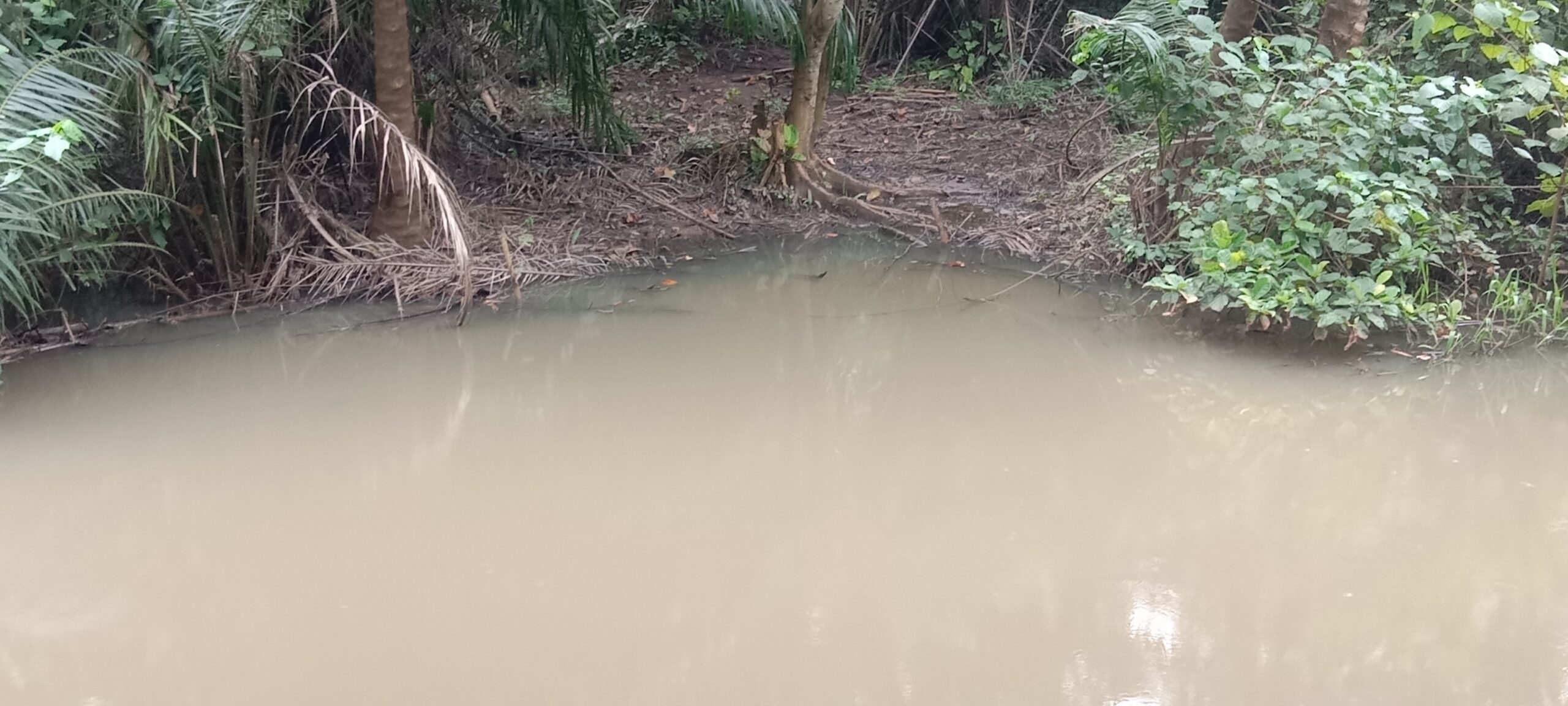
Oil spills have polluted the environment, including rivers. The vegetation has paled and wild animals have fled the area.
A river in Itajirin contaminated by oil spill
Farmers are the targets of oil thieves’ operations on NNPC pipelines.
As a step
Mr. Yaovi recalled how his 7-hectare maize and pepper farm burned down.
“I was at home when one of my sons, who went to the farm to monitor what we planted, came home and told me that the entire farm had been burned,” he said.
Senanou Yaovi
“In the seven hectares we planted corn and peppers, so you can imagine what we lost,” he added.
Unlike Mr. Odeyemi, who turned to selling water after losing his farm, Mr. Yaovi couldn’t think of any business other than farming, so he moved to another community.
On the new farmland he rented, Mr. Yaovi grows rice, beans, corn and watermelon. But he has run into another problem.
“Everything I planted there is not doing well because of the pests.”
He appealed to government agencies in the agricultural sector to help him and other farmers whose businesses have been affected by the oil spills.
Burst
In July 2018, Olalekan Ayinla was at her fish farm in Ogijo, Ilara area, Ogun State, when she heard an explosion at a nearby pipeline that had just been vandalized by oil thieves.
The pipeline that runs through Ilara is about an hour’s walk from Mr. Ayinla’s fish farm, but the contamination from the explosion killed all the fish.
ALSO READ: Shell must pay Nigerian farmers for oil spills, says Dutch court
“When I heard the explosion I rushed out of the farm because I wasn’t sure what had happened. The fire swept everywhere and my farm was not spared,” she said.
Solution
To curb the incessant vandalism on the pipelines, the Nigerian government has deployed different security teams including the police and civil defense (NSCDC). However, crime still persists in many states like Ogun.
Environmental advocates say that to stop pipeline vandalism, the government must shift its focus from oil production and transition to renewable energy.
Bassey and Mayokun Iyaomolere, an environmental activist, also called on the government to compensate the victims of the oil spills.
For his part, Iyaomolere said the technology offers the best protection for pipelines against vandals.
“I think the best way to protect the pipelines is to have some technological innovations that help monitor these pipelines so that if there is any illegal activity there is live coverage or something that transmits a signal to a venue where it can be quickly monitored and local forces will be quickly directed,” he said.
This report was produced with the support of the Center for Innovation and Development of Journalism.
Read More Related News Here
Let hear it in the comment below if you do have an opinion on this; Ogun farmers count losses as oil spills from shattered pipelines destroy farmland