
President Bola Tinubu recently assigned portfolios to ministers as part of efforts to push his “Hope Renewed” agenda for Nigerians.
The president divided the past Ministry of Mining and Steel Development into two: the Ministry of Steel Development and the Ministry of Solid Minerals Development.
This development comes against the backdrop of Tinubu’s campaign promise to revive the Ajaokuta steel complex if he is elected president. Therefore, the reorganization of the ministry can be attributed to the president’s commitment to prioritize the development of mineral resources in the country.
The new Ministry of Steel Development is expected to focus mainly on the moribund steel sector, with the Ajaokuta Steel Complex as its flagship, while the Ministry of Solid Minerals Development will continue to play its supervisory role as regulator of the sector.
Nigeria’s extractive sector is critical to economic diversification, but it is plagued by numerous challenges. While the challenges are not exhaustive, experts believe that some pertinent issues need to be addressed if the sector is to be productive and contribute significantly to the growth of the economy.
the roadmap
He Roadmap for Nigerian mining growth it was developed to address the many issues facing the sector with the aim of placing the mining sector on a global map. He highlighted immediate, short-, medium-, and long-term timelines for key actions.
According to the roadmap, “if Nigeria successfully implements the proposed recommendations, growth is expected to return to the sector through new exploration, operations and production activities from active mining, functional (and expanded) processing capacity and refining, and higher added value in exports. The net result will be the creation of thousands of direct jobs and potentially hundreds of thousands of indirect jobs. In addition, the impact on GDP will also be significant since industries will be able to better use the sector’s production, substituting imports”.
Henry Dele Alake (PHOTO CREDIT: George Kaduna)
Similarly, the roadmap stated that the sector should be able to contribute three percent of GDP by 2025.
However, the roadmap has not been implemented, seven years after its development. As a result, the sector still contributes less than one percent to national GDP, minerals are still largely exported without benefit, access to funds remains difficult for miners, gender inequality still thrives, and Nigeria still you have not used the inherent potential judiciously. in the sector.
Therefore, the new minister is expected to push for the implementation of the roadmap to ensure the overall growth and development of the sector.
Illegal minery
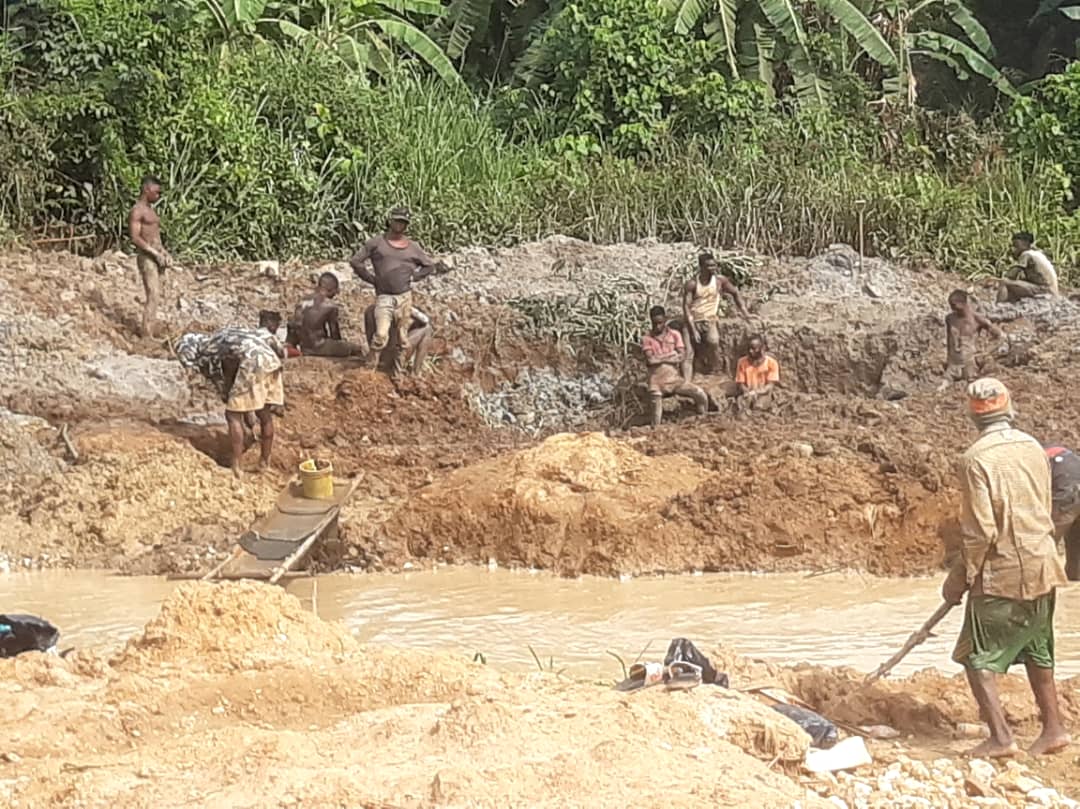
For decades, illegal mining activities have been rampant in the industry due to government negligence and neglect of the once thriving sector. Currently, 80 percent of mining operations in Nigeria are artisanal in nature and mainly informal. Illegal mining activities continue to sabotage the economy while corruption thrives.
Former Minister of State, Mining and Steel Development, Uchechukwu Ogar, confirmed that Nigeria loses $9 billion a year due to illegal gold mining and smuggling.
Unfortunately, some of these economic saboteurs are foreigners, doing so with the connivance of security personnel. Although several arrests have been made, the powers that be they often frustrated efforts to have them prosecuted, according to the immediate former minister, Olamilekan Adegbite.
In addition to loss of income, illegal and unregulated mining is also associated with environmental degradation, loss of livelihoods, conflict, and loss of cultural heritage, among others. Experts hope that the new minister will address the concern and apply appropriate regulatory controls in the sector.
The seven strategic minerals
Nigeria has more than 44 solid minerals identified across the country, but is prioritizing mining for seven based on data availability and economic feasibility. These minerals are gold, barite, iron ore, lead/zinc, coal, limestone, and bitumen. However, as time passes, it is necessary to review these minerals. In the era of energy transition, some of the previously identified strategic minerals are considered low priority. For example, coal is a major carbon emitter and a major contributor to global warming. There is a global debate about phasing out coal to mitigate climate change, although some experts are of the opinion that Nigeria’s (and indeed Africa’s) track record of technological and industrial growth makes such action counterproductive.
Also, baryte has many industrial uses, but it is mainly used as a drilling fluid in the oil and gas industry in Nigeria. As the world shifts its focus from fossil fuels to renewable energy, demand for baryte is expected to decline.
Therefore, the minister is expected to push these talks forward and make informed policy decisions that ensure proper development of the sector.
State and community participation and ownership
The constitution vests primary ownership and control of mineral resources in the Federal Government of Nigeria. This means that although the resources are in the states, they have little control over them. Experts have argued that the law is a significant detriment to the growth of the sector and one of the main reasons for the illegalities surrounding its operations. In 2021, former River State Governor, current FCT Minister Nyesom Wike, and his counterpart, Oyo State Governor Seyi Makinde, denounced the failure of the federal government to use its mineral resources to develop the nation. They called for states to be allowed to exploit their resources.
As the minister begins to think of ways to ensure the productive use of resources, experts hope these obstacles will be addressed.
Unsafety
Insecurity is one of the main challenges facing the solid minerals sector. For the sector to attract significant investment, security issues need to be seriously addressed. Mining, especially illegal mining, has been linked to insecurity in many communities. For example, in Zamfara, weapons are exchanged in search of minerals, and certain powerful and well-connected individuals conspire with foreign citizens to plunder the nation’s resources. Insecurity associated with mining activities includes community unrest, banditry, kidnapping, gender-based violence, and terrorism. Chinese citizens, for example, have been bound to the financing of militant groups and accused of abuses and inadequate salaries in the mining sector. The minister is expected to work with security agencies and other regulatory bodies to verify that the practice is so.
Tax Regime
One of the main challenges impeding growth in Nigeria’s solid minerals sector is the lack of a revenue formula. Although revenue generation in the industry is believed to have grown exponentially following the enactment of Nigeria’s Mining and Minerals Act in 2007, experts called this movement “still.” This “immobile movement” is linked to the absence of a clear tax regime in the sector. Some of the fiscal problems include the lack of a well-defined fiscal framework, erroneous and unreliable production statistics, revenue leakage, disproportionate and unjustified fiscal incentives, and the involvement of subnational governments. There is also the issue of multiple taxes in the sector, all of which the minister is expected to tackle to boost growth.
Solid Minerals Development Fund
The Solid Minerals Development Fund (SMDF) was created in 2007 to boost investment in the mining sector and as a way to reduce excessive dependence on the oil sector.
The fund is said to have been used for “strange expenses” such as the rehabilitation of roads and drainage in some states, the financing of the 2015 general elections and the African Cup of Nations. According to the findings, 738.7 billion naira and $3 million from the fund had been illegally disbursed for the aforementioned purposes.
If Mr. Alake wishes to develop Nigeria’s solid minerals sector, he must ensure the judicious use of the SMDF.
the experts speak
The president of Women in Mining Nigeria, Janet Adeyemi, told Newslodge that she hopes the new minister will cut costs by diverting proposed funds to attend international conferences to set up pilot projects across the country. She also urged the minister to promote indigenous conferences, support NGOs and have international conferences run by the private sector.
“That being said, the social impact of mining must be taken seriously. When you look at the social aspect of mining, it could also cripple society. An entire community can be wiped out and aquatic life can be lost through poisoned water,” he stated.
“In addition to the Environmental Impact Assessment (EIA), it is necessary to have a mining index, which we call ESG (Environmental, Social and Governance). ESG criteria must be taken seriously; then there should be a certification. Each company must be mapped according to its ESG component.
“It is time for Nigeria to upgrade its strategic minerals, noting that they should not be static and should constantly change based on global needs. “Our policies should not be equally static. We must continue to fine-tune it in line with global best practices. However, if we look at the mining sector, we don’t have data at this time. It is necessary to have complete data”.
ALSO READ: Senate takes steps to establish N5 billion Mineral Development Agency
Ms Adeyemi, a geologist, said the country’s legal framework needs to be updated in line with best practices to address gender and child labor issues.
He also pointed out that financing is a major problem in the sector.
“The Bank of Industry (BOI) should account for the 2.5 billion domiciled in its custody. Who has benefited from the 2.5 billion and for how many years? It has become a source of income for some people in the government. Given the looming global inflation, the government needs to boost access to quick loans because they are related to acquisitions.
“There is a need to build the sector through strong engagement with NGOs working in the sector because the ministry may never have the capacity to address the needs of all 774 local governments,” he said.
Another geologist and mining expert, Emily Achor-Offodile, spoke about the need to revisit the roadmap to assess where the country is and figure out the way forward.
He explained that turning the country into a mining center would mean “promoting and stimulating the benefit and added value of minerals to promote employment and wealth creation, sustained efforts in terms of foreign direct investment and capacity building for ministry personnel.” ”.
Amara Nwakpa, executive director of the Shehu Musa Yar’dua Center, said that policy adoption is essential to make the sector more productive.
“It is obvious that the extractive landscape is changing rapidly due to the global energy transition. As you can see, a lot of attention is now paid to solid minerals, especially critical raw materials. This is why we need a policy that covers some of these critical materials, ensuring that Nigeria plays a vital role in the critical minerals value chain,” he said.
Read More Related News Here
Let hear it in the comment below if you do have an opinion on this; ANALYSIS: Tasks ahead for Dele Alake in Nigeria’s solid minerals sector