
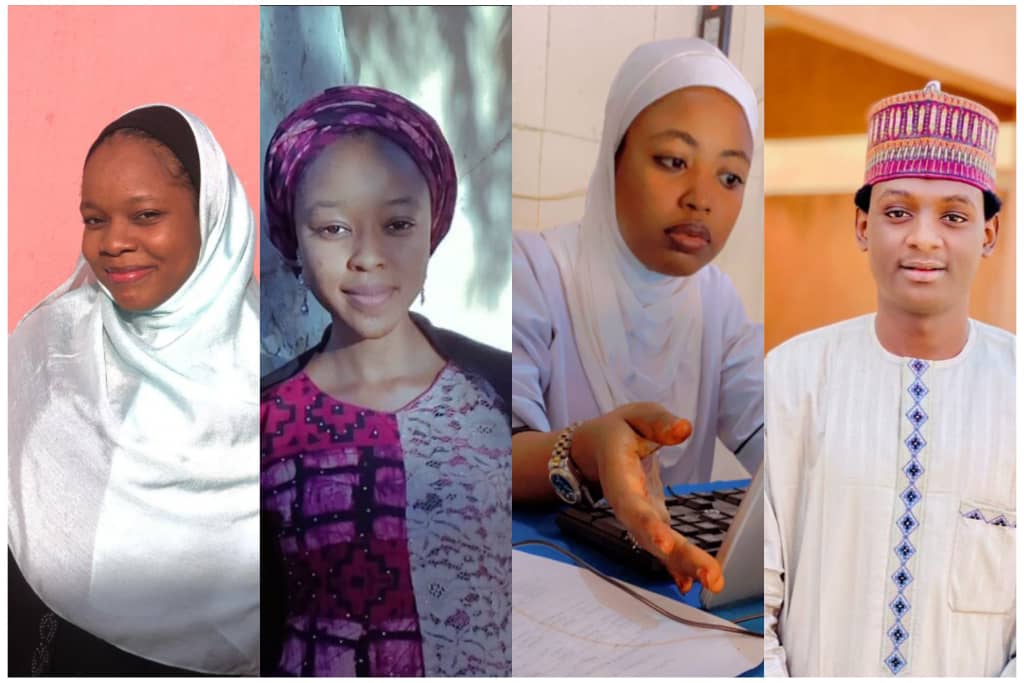
Aisha Sulaiman was counting down to September, when she will take her final exam at Maryam Abacha University in Maradi, Republic of Niger.
The country’s democratically elected government was then overthrown by troops from the country’s Presidential Guard. He no longer looks forward to that exam.
“With the borders closed, I won’t have access to the country, and even if I did, there is tension between the citizens and us students because of our president’s intervention,” Sulaiman, a 500-level nursing student, told Newslodge in a series of WhatsApp messages.
Aisha Sulaiman in her training uniform at a hospital in Kats
Ms Sulaiman, who is currently at Katsina undergoing her clinical training, said she worries that all the years she has spent studying her will be wasted.
“I am not happy with the coup because Bazoum is a good man,” said Ms Sulaiman. “Bazoum has made a lot of changes in Niger. For example, Maradi now has paved roads with water drainage on almost every street.”
Last month, soldiers from the Presidential Guard unit forcibly seized power from the democratically elected administration of President Mohamed Bazoum. The coup drew widespread condemnation from international and regional organizations.
Nigeria, which heads the Economic Community of West African States (ECOWAS), closed its borders with Niger as part of sanctions to force the military junta to relinquish power, including threatening to use a regional military force to remove the power board. Nigeria also cut off electricity supply to the country.
In a quick reaction, the board cut diplomatic ties with Nigeria, the United States, France and Togo, in a television announcement by his spokesman, Amadou Abdrahmane.
The suspension of diplomatic relations between Nigeria and Niger is affecting trade and other forms of cooperation, including education between the two countries. Some of those affected are Nigerian students studying in Niger who have been unable to cross the border to complete their studies.
Universities in the Republic of Niger were on vacation when the junta took power.
“We fear what will happen when the semester vacation runs out,” said Abdurrashid El-Ladan, a 500-level student at the Maryam Abacha University Medical Laboratory in Maradi.
Abdurrashid El-Ladan, a Katsina resident studying in Maradi
“It is normal for students like me, who are in our last year, to be afraid. We will simply go (in September) to do our final authorization (preparation for the exams)”.
Asked by Newslodge what his options are if the situation deteriorates further, Katsina resident El-Ladan said he hoped the stalemate would be resolved soon.
“We will continue to pray that it be resolved amicably.”
A few years ago, private universities (many of which are Nigerian-owned) and other higher education institutions began to spring up in Maradi and Zinder in the Republic of Niger to attract international students, mainly Nigerians living in states like Katsina. , Zamfara and Sokoto, along with the long border between the two countries.
The government of the Republic of Kano and Niger have an existing student. exchange program that started in 2013, while some northern Nigerian politicians regularly sponsor students from their constituency to study in Niger.
“Their schools have a perfect educational environment. Most of us drop out of Nigerian schools to go to the Republic of Niger because they don’t go on strike, unlike Nigeria,” Mustapha Yusuf, a graduate of Maryam Abacha University, told Newslodge.
Now, the “quiet” academic calendar is threatened by the coup and the resulting sanctions.
“The Nigerian government is not thinking about the relationship in terms of educational exchange between the two countries, as was the case with the stranded Sudanese students.
“We hope our government will recognize the military junta and enter into a dialogue to resolve the situation so that commercial activities along the border are restored,” said Aminu El-Ladan, a senior Katsina state official whose son is a student. in Maradi.
Hauwa Usman-Shehu, 19, and her sister, Fatima Usman-Shehu, 18, echoed the sentiments of other students who spoke to Newslodge. For the two daughters of a retired civil servant, studying in the Republic of Niger was their only option before the coup. Now they do not know what to do next if the diplomatic stalemate drags on for a long time.
Fatima Usman – Shehu, a Nigerian studying in the Republic of Niger
The sisters are 200-level Nursing and Midwifery students at Abubakar Ibrahim International University in Maradi.
“To be honest, the coup has put us in a worrying situation,” Hauwa’u said.
“It is more worrying, especially since we are about to return to school. We cannot enter the country (Republic of Niger) due to border closures, which will affect our studies. We are happy that we are making progress in our studies, but with this development, we will have no choice but to pray and hope that the situation improves,” he added.
He said that he feared that he would have to start his studies again in Nigeria.
ALSO READ: Coup in Niger: Junta Hints at Transition After Meeting with ECOWAS Delegation
Her younger sister, Fatima, has similar concerns. The idea of ”wasting” a year waiting to sit on the Joint Board of Admission and Enrollment (JAMB) The exam terrifies her.
He expressed that the military junta will open borders for the students.
“It’s not a situation I would want someone to be in,” he said. “I regret our situation because some people are in the last year of their studies. If at our level, we have done a lot in the year that we finished. Now, in the second year, we will waste a lot of time if we go back to Nigeria and continue our studies.”
Hauwa Usman – Shehu, a Nigerian studying nursing in the Republic of Niger
Read More Related News Here
Let hear it in the comment below if you do have an opinion on this; The future of Nigerians studying in Niger is uncertain as diplomatic relations between the two countries deteriorate