
Residents of Jigawa state were not surprised when President Bola Tinubu nominated their immediate former governor, Muhammad Badaru, for a ministerial appointment. After all, he was the leader of the ruling All Progressive Congress (APC) in the northwestern state.
Mr. Badaru left office in May at the height of his political power in Jigawa, having virtually handpicked Umar Namadi, a member of the political movement he founded, the ‘Badaru Disciplines’, as his successor.
Unlike other states, none of Jigawa’s political elites questioned Namadi’s nomination. One of the leaders of his group, Zakari Kafin-Hausa, a contractor and politician, was among those who were quick to praise the president for the appointment, describing the former governor as a grassroots politician and an easy-going person.
However, many eyebrows were raised over his post to headline the Ministry of Defence, since he was only known as a businessman before entering politics. Mr. Badaru was a scrap metal dealer before turning his Talamiz Nigeria Limited into a construction conglomerate.
Now he has joined a long list of Nigerian politicians appointed to head the defense ministry with no experience in the security sector. This has raised concerns in some quarters about its ability to get the job done at a time when Nigeria faces various security challenges.
The geopolitical zone of northwestern Nigeria is under siege by terrorists, locally called bandits. Mass kidnappings and kidnappings for extortion are rampant in five of the region’s seven states: Kaduna, Kebbi, Sokoto, Katsina and Zamfara. The two exceptions have been Mr. Badaru’s Jigawa and Kano’s sister state; the two were one state until they split in 1991.
Former President Muhammadu Buhari appointed a retired Zamfara state army general, Masur Dan-Ali, as defense minister in his first term from 2015 to 2019. In that period, the minister’s home state became the epicenter of banditry , despite the fact that the Inspector General of Police, Muhammed Abubakar, is also appointed by the state.
The security crisis in Zamfara was thought to have escalated at that time because Governor Abdulaziz Yari and Mr. Dan-Ali were not ready to work together to address the crisis. Yari generally acquitted himself of blame by pointing out that he had no control over security personnel despite being the head of state security, while Dan-Ali claimed a lack of political support for his plans from the government. state.
Jigawa also recorded cases of violence by non-state actors between 2015 and 2016 in the Gwaram local government area, where kidnappers called ‘Yan Leda’ were active. But between 2017 and early 2018, the criminals faded away. Badaru, at the time, credited his own political will for development.
Last February, Mr. Badaru told the ‘Business Made Easy’ team of the Presidential Council for the Business Environment (PEBEC) how his state managed to remain relatively safe from banditry in the northwest region.
He said the atrocities were not experienced in Jigawa because his government had tackled the roots of banditry.
He said that the administration of Saminu Turaki (1999-2007) “allowed the Fulani to use cattle routes and, to some extent, forest reserves”, while disputes between farmers and herders were discussed and settled amicably.
“When Sule Lamido (2007-2015) arrived, he continued with the initiative, he began to provide water in the grazing reserves and to build schools for nomads. When I entered, I continued with the provision of water and the demarcation of livestock routes,” said Mr. Badaru.
“We introduced mobile veterinary services in 30 districts that allow herders to get veterinary services in their own villages, giving them a sense of belonging.”
Badaru said the policy prevented cattle rustling and killings, adding that it provided the basis for the peace the state enjoyed today.
“If suspicious characters come to Jigawa, we get information from the resident Fulani that those people have arrived and we don’t trust them,” he said.
Badaru said the absence of a similar policy in some states led to the banditry that is now rampant in those states.
“But this wasn’t handled well elsewhere and that’s probably why you see the escalation. And some states were affected by the threat due to their proximity to states prone to banditry. If they had dealt with the problem in the same way that Jigawa did, that could not have happened,” he said.
In truth, in his tenure as governor, Jigawa was one of the relatively peaceful states in the northwest. Should this offer expect his addition as defense minister to have a positive impact on the security situation in Nigeria, especially in the northwest?
Vows to review past reports on insecurity
Badaru and his state minister, Bello Matawalle, took up their posts at the ministry’s headquarters in Abuja on Tuesday.
Badaru, in his comments shortly after officially taking over from Ibrahim Kana, the ministry’s permanent secretary, vowed to review previous reports on insecurity in the country.
He said they would not betray President Tinubu’s trust and tasked the service chiefs with giving him a timetable and requirements to solve Nigeria’s security challenges.
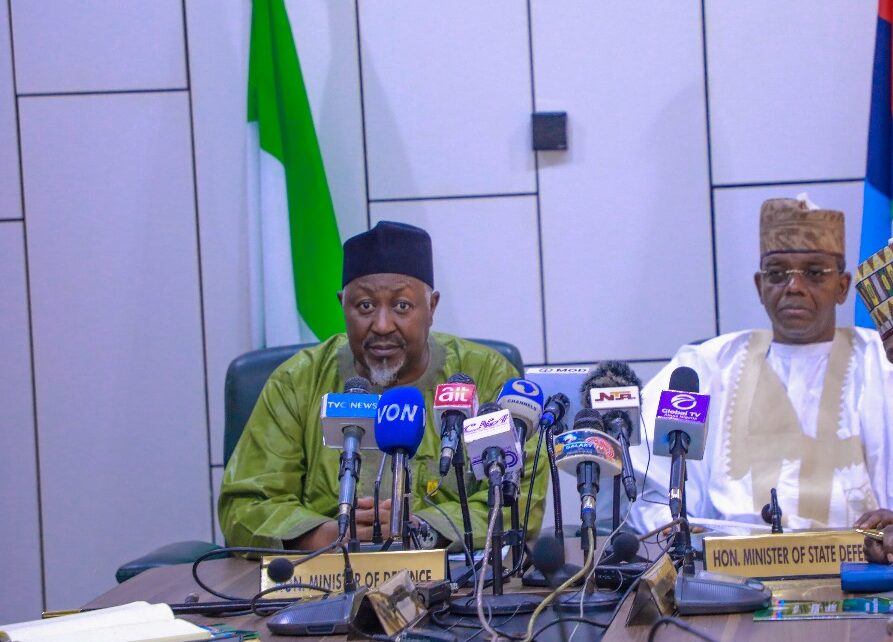
Defense Minister Alhaji Muhammed Badaru Abubakar MON mni and Hon. Minister of State for Defense Dr. Bello Mohammed MON at the Ministry of Defence, Ship House, Abuja on Tuesday 22 August 2023. [PHOTO CREDIT: @NigerianNavy]“This timeline and target will be relayed to the president, and I am confident that he will be monitoring us.
“The president is ready to give us all the support we need to succeed because he is a winner and has no patience for failure.
“For the good of our country, we know that without security there will be no investment, and without investment there will be no economic growth,” Badaru said.
The minister assured that his management will mean a notable change in the country’s security situation and promised not to joke with the appointment.
Defense ministry leadership
A mix of security sector professionals and politicians from different backgrounds have run the defense ministry since Nigeria returned to a democratic system of government in 1999.
The first president, Olusegun Obasanjo, a former army general, appointed another former army general, Yakubu Danjuma, as defense minister until 2003, when he replaced him with a former Kano governor, Rabiu Kwankwaso.
ALSO READ: Badaru, Matawalle take up duty, pledge strong defense apparatus to counter emerging threats
Yayale Ahmed, who later stepped down to become federation government secretary, succeeded Mr. Kwankwaso in 2007 and served until 2008. Mustapha Shettima headed the ministry from 2008 to 2009; Godwin Abbe from 2009 to 2010; and Adetokunbo Kayode from 2010 to 2011.
A retired customs officer, Bello Halliru, was defense minister from 2011 to 2014 and was succeeded by a retired army general, Aliyu Gusau, who led the ministry until the end of President Goodluck Jonathan’s administration in 2015.
Mr. Dan-Ali, also a retired general from Zamfara, succeeded Mr. Gusau, while Bashir Magashi from Kano State, also a retired army officer, succeeded Mr. Dan-Ali.
Profile of the new defense minister
Born on September 29, 1962 in the Babura Local Government Area of Jigawa State, the new defense minister attended Babura Central Elementary School from 1970 and then the famous Rumfa College, Kano, where he completed his secondary education. in 1981.
He proceeded to Ahmadu Bello University, Zaria for its advanced level and then graduated with a Bachelor of Science in Accounting in 1985.
He worked in the former Kano State Civil Service as an auditor in the audit department of the Ministry of Finance. He later resigned and established his own business. He incorporated Talamiz Nigeria Limited, which later gave rise to subsidiaries such as Talamiz Motors, Talamiz Consumer Company, Talamiz Transport, Talamiz Commodities, Talamiz Properties, Talamiz Poultry and Farms, and Talamiz Petroleum.
Others in the group include Talamiz Oil Mill Limited, Socar Talamiz Limited, RMR Shipping Bv, AML Bonded Terminal and ALUAFRIC Cairo. Mr. Badaru was also a director of Sahih Nigeria Limited.
He was president of the Jigawa State Chamber of Commerce, Industries, Mines and Agriculture; President of the Nigerian Association of Chambers of Commerce, Industries, Mines and Agriculture (NACCIMA); President of the Nigeria-Niger Chambers of Commerce; President of the Northern States Chamber of Commerce; Chairman of the Board of Trustees of the Northern States Chamber of Commerce; and Chairman of the Jigawa State National Association of Road Transport Owners.
Mr. Badaru served as a member of the presidential advisory committee on the Industrial Revolution Plan. He was also a board member of the Nigerian/American Chambers of Commerce and the Nigerian Institute of Industrial and Corporate Administration. He was also a board member of the Nigerian and Belgian Chambers of Commerce, a member of the National Privatization Council, a member of the NSME National Council and a delegate to the 2014 National Conference.
He was a director of Africa Merchant Bank Limited and Bank of the North Limited, now Unity Bank Plc, and patron of the Rice Farmers Association, Kano, and Nigeria Union of Journalists, Jigawa State. Mr. Badaru is a member of the Nigerian Association of National Accountants, FCNA, and a holder of the title of Member of the Order of the Niger, which was conferred on him in 2006.
Badaru first ran for governor in 2011, under the defunct Action Congress of Nigeria (ACN), but lost the general election to Governor Sule Lamido of the Peoples’ Democratic Party (PDP). Four years later, in 2015, he won the seat under the All Progressive Congress. (APC).
He was Chairman of the President’s Fertilizer Committee and also Chairman of the President’s Non-Noill Revenue Committee. He chaired the APC National Election Convention Committee and was the Chairman of the APC Election Committee.
Read More Related News Here
Let hear it in the comment below if you do have an opinion on this; From governor of the Northwest ‘island of peace’ to defense minister